
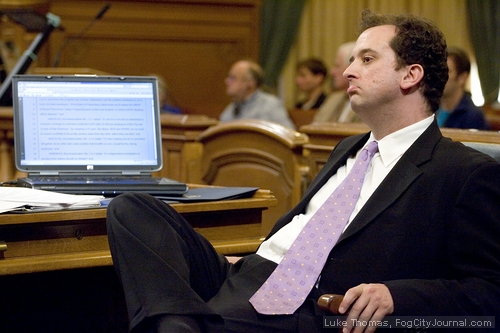
Supervisor Sean Elsbernd.
Photo by Luke Thomas
By Hope Johnson
January 26, 2010
District 7 Supervisor Sean Elsbernd is mad as hell that a city charter amendment he urged voters pass in 2007 is not as fiscally responsible as previously hoped. He’s made it clear someone is going to pay for his mistake and it damn well better not be him.
Elsbernd appears prepared to throw Muni operators under the bus in a quest to change his own error.
Only several years ago the supervisor urged voters to pass Prop A, a transit reform measure he assured was “a comprehensive reform plan” creating “stronger accountability” and bringing “employees back to the bargaining table.” Instead, Prop A hampered San Francisco’s ability to negotiate compensation with Muni drivers by purposefully changing the maximum the City was required to pay operators into the bare minimum it was allowed to offer.
The inconvenient truth for Elsbernd is he knew Muni operator wages and benefits were already based on the highest salaries in the country when he advocated the City place this restriction on itself.
Now Elsbernd is prepared to change the error of his ways but has chosen to portray Muni operators as the bad actors. In an attempt to garner public support for and ramrod through an amendment measure by February 8th for the June ballot, he has stirred up public ire by focusing not on operator wages but on a potentially controversial benefit tied to those wages. The union claims Muni operators receive less in health benefits than other city workers and the yearly monetary benefit in question is intended to make up for that disparity.
Elsbernd admitted to the Board of Supervisors Rules Committee during a review of his ballot proposal last week that the status of the health benefits was still at issue and required additional investigation. Appallingly, he nonetheless referred in the press to the potential health benefit of these average workers as a “Christmas bonus,” leaving the public with the impression drivers are receiving undeserved compensation. Equally deplorable, local mainstream media has followed Elsbernd’s lead and implied blame on Muni operators, failing to disclose Elsbernd’s support of Prop A or explain that wages and benefits at issue were imposed on the City by itself through no fault of the union (see examples here, here, and here).
Despite drawing media attention to the controversy of the benefit, Elsbernd also admitted to the Rules Committee that he was more interested in changing the way the City negotiates wages than amending the health care benefit, stating, “The health care issue is a very small part of the issue.”
One can only respond to that with Senator Barney Frank’s question: “On what planet do you spend most of your time?” Health care is never a very “small part” of any worker’s benefit package, at least, not to the worker. And it’s outrageous to suggest otherwise in light of the health care debate in Congress.
Clearly, an amendment to change wage and benefit negotiations is not ready for the June ballot. The last thing we need is another politician meddling in health care benefits by imposing unnecessary deadlines. If the union’s health benefit claim is deemed to be unwarranted after investigation, an amendment can be sent before the voters in November. The Rules Committee is scheduled to hear the proposal again on Thursday and should aim for a more comprehensive amendment measure to be placed on the ballot in November.
Waiting until November will not damage efforts to reduce the looming $70 million budget deficit faced by the Municipal Transportation Authority (MTA), the body responsible for managing Muni. Changing to bargaining for compensation would have no positive fiscal impact on the massive deficit coming up in July, whether the change is approved in June or November.
In fact, Elsbernd’s proposal distracts from the fact the MTA Board of Directors have done a terrible job of pursuing new forms of revenue for cash-strapped Muni, even removing from their proposed budget extended parking meter hours that would have already brought in $4.5 million had it been enacted with the budget.
Increased Muni fares and service cuts became effective December 5th but the MTA still seeks additional increased fares and cuts to overcome the huge budget deficit. Many are now left wondering if the MTA Directors have limited their revenue options to only those acceptable by the Mayor, who currently appoints all Directors to the MTA Board. Revenue measures unpopular with the Mayor and his allies are routinely dismissed as viable options. When that concern was mentioned at public comment during the MTA Board meeting on January 19th, it elicited an immediate defensive reaction from MTA Executive Director Nathaniel Ford and other Board members.
San Francisco is the only city in the country where public transit ridership increased this year. People here want to use public transit! It’s time to admit the MTA Board needs to be held accountable to more than just one person.
All available revenue options need to be up for consideration at a time when the MTA has declared a fiscal emergency, not simply those that will make the Mayor popular or his allies happy. Prop E created the MTA in 1999 and section 8A.109 sets forth that “the Agency diligently shall seek to develop new sources of funding.” Removal of the extended parking meter hours from the budget and this latest attack on the reputation of Muni drivers by a mayoral ally are further evidence the time has come for the voting public to have more sway over the MTA Board of Directors.
In addition to a measure revising operator wage and benefit compensation formulas, the November ballot needs a measure providing the Board of Supervisors power to appoint some members of the MTA’s Board.

 The Hunger Site
January 30, 2010 at 12:32 am
Ye Olde Cittey Chartre:
SEC. 8A.109. – ADDITIONAL SOURCES OF REVENUE.
(a)
To the extent allowed by law, the Board of Supervisors may, by ordinance, dedicate to the Agency revenues from sources such as gas taxes, motor vehicle licensing taxes or other available motor vehicle-related revenue sources.
(b)
The Mayor, the Board of Supervisors, and the Agency diligently shall seek to develop new sources of funding for the Agency’s operations, including sources of funding dedicated to the support of such operations, which can be used to supplement or replace that portion of the Municipal Transportation Fund consisting of appropriations from the General Fund of the City and County. Unless prohibited by preemptive state law, the Agency may submit any proposal for increased or reallocated funding to support all or a portion of the operations of the Agency, including, without limitation, a tax or special assessment directly to the electorate for approval, or to the owners of property or businesses to be specially assessed, or to any other persons or entities whose approval may be legally required, without the further approval of the Mayor or the Board of Supervisors. The Agency shall be authorized to conduct any necessary studies in connection with considering, developing, or proposing such revenue sources.
(Added November 1999; Amended by Proposition A, Approved 11/6/2007)
January 28, 2010 at 9:56 am
Hope, thanks for your illuminating story. As a member of the MTA CAC, we are beginning to look at budget options — there aren’t many, but I do favor many pf the proposals made in a SPUR white sheet that came out last year. Also, I am beginning to get to know the SFMTA, as I was only appointed in August of last year. I would like to see a spreadsheet of staff and salaries, but it’s my understanding right now that Muni has fewer mid-level management positions compared to other transit agencies. Again, I need to see a spreadsheet of some sort that demonstrates that.
In the meantime, our current car-dependent lifestyle is not sustainable and no economy that is based on this particular lifestyle can possibly last. I would like to see some change in the language of the charter that specifically acknowledges this reality and mandates that the members of the board of directors — and the MTA CAC — take this reality into consideration as they are deliberating.
January 27, 2010 at 4:26 pm
I want to see MUNI cuts at the mid-management level and salary cuts at upper management period. These are dire times and the banksters aren’t the only ones cruising through the dep/recession. MTA is a boondoggle that needs an overhaul by a focused Board of Sups and mayor that actually shows up. I say open the books, let in the sunshine, and let’s see MTA’s accounting.
January 27, 2010 at 1:51 pm
No sinister or hidden agenda about “revenue options.†It’s just a common term in funding discussions, and yes, sometimes means taxes and fees. The State does it for autos (license fees, gas tax, etc.), sometimes even benefiting big oil that gives little back to the State while making record profits in a depression. The MTA doesn’t need to apologize for needing funds just like every other agency or department.
Some options I have heard for discussion, research, and testing are below. I respond because I want to use public transit, not because I “should.†People who have accepted committee and board positions or paying jobs are the ones who have agreed to the “shoulds.†Because I am not one of the shoulds, I am not privy to the current status of these suggestions.
Extend parking meter hours to include Sundays and evenings. (I have to pay to use the bus at those times. Why are autos special? It’s not controversial to share the pain in fiscal emergencies. Small revenues add up.)
Renegotiate work orders and MOUs. (Ex.: Eliminate fringe benefits like paying SFPD to park free in North Beach garages and split costs when services such as traffic enforcement for an event benefit other city agencies).
Emphasize the use of 511 instead of 311 for next bus info. 311 charges call costs to the MTA.
Add meters to areas like SOMA.
Evaluate middle management salaries and tasks. Include people for pedestrian and bicycle traffic who have experience with generating revenue in those areas.
Allocate stimulus money from the Central Subway project to Muni so subway will be part of a reliable and sustainable system.
Amend City Charter as needed for contract negotiations after appropriate investigation based on need not arbitrary political deadlines.
Provide the Board of Supervisors with appointment power to the MTA Board to ensure options unpopular with Rob Anderson and Gavin Newsom are fully and accurately explored.
January 27, 2010 at 8:35 am
“Revenue options” mean taxes and fees. The $4.5 million from parking meters is a drop in the bucket that risks a lot of negative feedback. If Johnson has some specific “options” to raise more money, she should share them with us.
January 26, 2010 at 3:56 pm
Progressives for years have rolled out Muni reforms to the San Francisco voters year in and year out only to be burnt by the Moderate Kool Aiders. San Francisco only get what it deserves. Until the wind blows away the these “lines in the sand” expect more of these boondoggles. But that’s politics San Francisco style, whether you like it or not.