
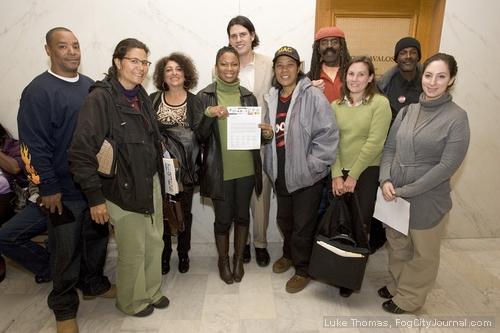
Several members of laborer's union, Local 261, posed for a photo with Brightline Defense Executive Director Joshua Arce moments before a hearing at City Hall got underway, 5/10/10, to investigate why local disadvantaged workforce hiring contract provisions between the City and County of San Francisco and Recurrent Energy have not been fulfilled. From left to right: John Butler (Laborers Local 261), Mary Alice Rodrigues (San Francisco Conservation Corps), Mindy Kener (Anders & Anders), Fathina Holmes (Young Community Developers), Joshua Arce (Brightline), Lisa Fatoui (Hunters View Mothers Committee), Terry Anders (Anders & Anders), June Brashares (Global Exchange), Leaotis Martin (Laborers Local 261), and Antonia Malhi (Global Exchange). Photos by Luke Thomas.
May 17, 2010
When San Francisco’s Sunset Reservoir solar project is completed later this year it will be one of the largest solar installations of its kind in the country. The project, a 5-megawatt sea of 25,000 solar panels in San Francisco’s Sunset District, was approved in June after a revised commitment from the developer, Recurrent Energy, to hire no less than 21 workers from San Francisco’s most economically disadvantaged communities; 30 percent of the project’s workforce.
However, with the number of workers from this demographic firmly stuck at 7 (with some of those employed feeling marginalized), and media reports claiming that an increasing share of work for the electricians’ union, Local 6, has blocked opportunities for low-income San Franciscans in the laborers’ union, Local 261, Supervisor Eric Mar called a hearing last week to investigate the status of the hiring practices at the Reservoir.
The importance of an increased investment in renewable energy accompanied with the promise of green jobs opportunities for qualified economically disadvantaged people from targeted communities, originally earned support from Supervisor Mar as well as a host of national and local environmental groups, including Green for All, the Sierra Club, and the Ella Baker Center for Human Rights.
Mar’s decision to oppose his colleagues on the Board of Supervisors who were asking for more time to assess the Recurrent Energy bid properly and see if it really was the best deal for taxpayers, led some to question his political nous. But there was a lot of pressure from non-governmental groups to push the deal through, and quickly. (It turns out that construction only began in March, meaning that there was time to further improve the terms of deal for the city as well as tie off any loose ends in workforce hiring provisions).
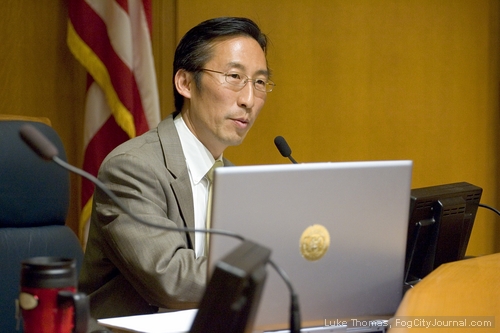
Supervisor Eric Mar.
On the one hand, environmental groups like the Sierra Club were blinkered in their pursuit of the only solar energy contract that was left on the table. A source from Sierra Club claimed at the time, “In their eyes, a quick private deal for 5 megawatts is better than no megawatts in the next year,” thereby creating a false sense of immediacy for clean energy benefits. And Mayor Gavin Newsom, who was running for governor at the time, stood to benefit from a hastily penned agreement which he was quick to tout as a “green” accomplishment in his ‘vote for me’ campaign rhetoric.
And on the other hand, workforce organizations such as Joshua Arce’s Brightline Defense Project, lobbied in support of the contract primarily as an opportunity to get underemployed disadvantaged workers back into jobs with prospects for green jobs apprenticeship training for future solar installation projects in the city.
During last week’s Land Use Committee hearing on the matter, the mayor’s Office of Economic and Workforce Development (OEWD) provided figures claiming 52 percent of the work hours were performed by San Franciscans. The OEWD even lists the city’s zip codes and how many workers come from each. So San Franciscans are getting hired – 19 of the Sunset Reservoir workers are from San Francisco, and 22 aren’t – but the crux of the matter is, who is getting hired, and what type of work and training is being provided to disadvantaged workers?
OWED Executive Director Guillermo Rodriguez stressed, “The hiring plan for remaining positions will meet and surpass the First Source Hiring Agreement (FHSA).” The FHSA states that Recurrent Energy, and therefore its subcontractor, Bass Electric, must hire 1 electrician and 20 laborers, all referred by a branch of the OEWD called CityBuild.

Mayor's Office of Economic and Workforce Development Executuve Director Guillermo Rodriguez.
CityBuild is an employment program that provides workforce training and job placement services for San Francisco residents interested in pursuing a career in the construction industry. CityBuild also claims to “assist contractors that have been awarded projects in San Francisco with fulfilling their local hiring obligations.”
Mindy Kener, a job developer at Anders & Anders Foundation, which recruits laborers by “working with ex-offenders and drug rehabilitation centers,” stated in no uncertain terms that SFPUC General Manager Ed Harrington had “promised 21 workers from disadvantaged zip-codes… from the start. Not when they (Recurrent Energy) have two months left of work.”
Harrington’s role in this public-private mutant should not be overlooked. As head of the Public Utilities Commission, it was his responsibility to negotiate the best deal for the City. Instead, he used his influence to gain Supervisor Mar’s support for the Recurrent Energy deal despite admitting it was “expensive.” Mar, in turn, provided the swing vote in support of the contract despite prudent calls from the left for further review and analysis to ensure taxpayers were getting the best deal possible.

SFPUC General Manager Ed Harrington.
As the deal stands, the City and County of San Francisco is locked into a 25-year contract and is required to pay Recurrent Energy $235 per megawatt-hour of energy generated. Though the City would have a buyout option at years seven and fifteen, the buyout price is fixed at $33 million, or fair market value – whichever is higher.
At the time, the deal was lauded by advocates for local hiring of disadvantaged workers: “We thought that we found a balance between securing work for the electricians as well as work for laborers from places like Bayview, Visitacion Valley, and the Excelsior,” said Kener in a statement released by Brightline.
However, the truth is more divisive than anyone could have expected.
“The reason this very nuanced approach came about is that we couldn’t guarantee that folks from these communities would have the opportunity to work on the project through Local 6,” Arce stated at the hearing.

Brightline Defense Project Executive Director Joshua Arce.
So Arce and Brightline Defense did what it had to do: pushed workers through Local 261, which has a Collective Bargaining Agreement (CPA) with the City, enabling their workers to get jobs on city projects.
Out of 41 construction workers reported on the project, 31 are electricians, 8 are laborers, and 2 are operators. But the statistics show that only 1 electrician is from San Francisco and the rest are from out of town. Rodriguez said that in ongoing attempts to reach a CPA with Local 6, the union had only been “accessible at times,” drawing a titter from the crowd. He also said the “CPA does not allow the contractor to ‘name-call’ an individual.”
So if Bass Electric needs to hire an electrician, it’s not allowed to use the e-word?
The non-delivery of disadvantaged community hiring promises made boils down to an intra-union dispute over who’s getting hired first, and who’s not. Says Arce, “It’s about fulfilling a commitment to low-income communities. It’s about building solar careers.” He stressed that he wanted the contractor to “commit to hands-on solar training” for the laborers, including “skills that translate to other projects in the city.” He complained that working on the project had “not been a solar experience” for the laborers, meaning they are not being provided solar installation training.
One question the hearing raised was who was responsible for enforcing the terms of the contract and what would happen if they weren’t fulfilled? As a public-private partnership, hiring practices are the shared responsibility between mayor’s office and Recurrent Energy. Arce claimed that the onus was on the City to prove a “lack of good faith” and “tried-your-best is not enough.”
Recurrent Energy VP of Engineering Pat Caramante testified he was not involved in the hiring practices and passed responsibility onto Bass Electric, the general contractor, who was under pressure to fulfill its contractual obligations with Recurrent Energy and was pressured from Local 6 to hire their electricians.
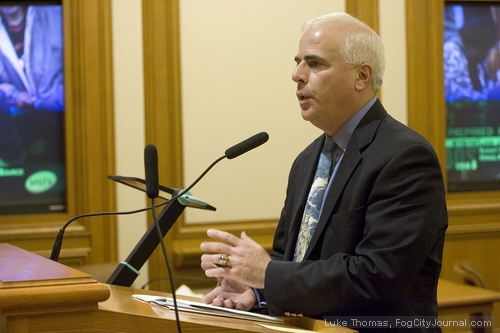
Recurrent Energy VP of Engineering Pat Caramante.
Jeffrey Yee, of Bass Electric, was quizzed by Supervisor Sophie Maxwell as to the exact nature of the work that the laborers were doing on the project. He cagily admitted “civil, structural and concrete work,” and that, “electricians do all of the electrical work.”
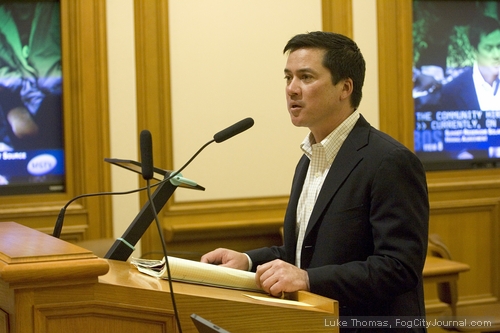
Bass Electric President Jeffrey Yee.
David De La Torre, of Local 261, claims that his union had been promised 21 hires, but no more laborers are being hired since electricians have taken over the remaining work. John Butler, a laborer with Local 261, said, “We were promised jobs. I have been installing solar panels since the eighties. It’s not that difficult. I joined the laborers’ union for this reason, and only 2 people got hired from my class.”
A laborer who actually works at the reservoir claimed that he “started working with electricians on solar panels, then it was snatched away from me. All I can do now is dig ditches.” His hours have been cut down to three days a week. “They won’t let us do anything,” he said.
But electricians and Local 6 sees this as a breach of the carefully delineated boundaries that define their very profession. In other words, they don’t like someone else doing their work.
Supervisor Maxwell, a former electrician herself, repeatedly stressed that it was, and had been difficult working with the electrician’s union, that they had not been willing to open up apprenticeships, and that “when they were not out of work, this was still the case. We all need to talk, to make relationships better,” she said.

Land Use Committee Chair, Supervisor Sophie Maxwell.
Jeffrey Phillips of Local 6 countered that he would be happy to take on some of these workers as electricians in his union, but they couldn’t do the algebra: “Kids need to be taught math in school so they can pass out electricians’ exams,” he said, adding that he hoped the laborers would join their union instead.
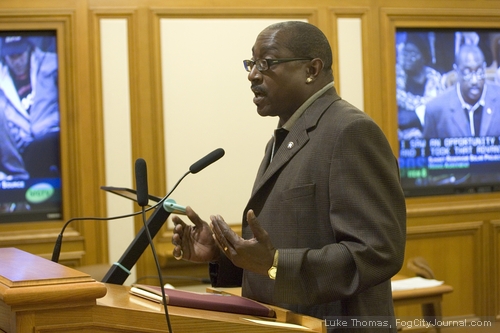
Jeffrey Phillips, Local 6.
Maxwell summed up: “It’s important as working people not to be pitted against each other… as people we all need to stand together.”
Maxwell’s sentiments were echoed by Ronda Simmons, Director of Workforce Development, who said, “It’s going to take the boldest thinking we’ve ever done,” to sit down and work this out together.
De La Torre says that laborers are multi-skilled and should be allowed to do any work they are qualified to perform. “If it means that we have to hold Bass Electric’s feet to the fire, we will.”
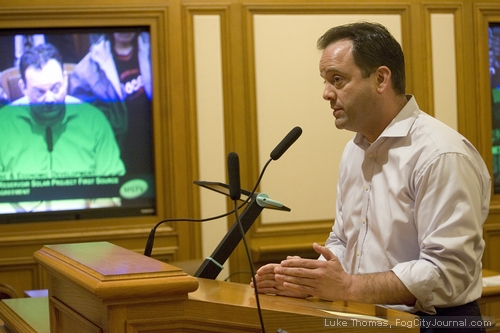
David De La Torre, Local 261.
Eric Brooks of the SF Green Party argued that only a mandatory local hiring ordinance with specificity would solve this issue. He also claimed that Local 6 had opposed Prop H in 2008 and other local moves toward cleaner large scale public energy, under pressure from its primary employer, PG&E. Citing this collusion with PG&E, and Local 6’s turf battles against local hiring, Brooks said of Local 6: “They need to step up for the community if they want support.”
In an interview with Fog City Journal, Arce conceded the City’s contract with Recurrent Energy was “not as good as it could be,” and expressed concerns that similar issues may arise when the City implements the “holy grail of Community Choice Aggregation.”
The bottom line is, this is a story about how less than ideal contracts get rushed through the legislative process for the benefit of political gain at the expense of taxpayer interests. It is a clear case of squandered political capital for political expediency.
Luke Thomas contributed to this report.


 The Hunger Site
May 21, 2010 at 3:46 pm
Josh,
So you got a big chunk of money from a secret place and now you support a staff, office and home on $25k? Damn, you’re really good with money.
Again, you’ve evaded my question. Will you say right now that SF would be better off without PG&E?
That’s simple. They’re a horrible corporation. Say that. Look what they’re doing to Marin’s CCA. Condemn them. C’mon, let’s hear you tell PG&E to get out of town. It’s done like this:
PG&E get out of San Francisco!!!
You ready to sign on for that one?
Now, give us the link to that financial data you said you’d post on your web site but is now a secret court document from when you were a hero.
The ‘Lawrence’ comment meant just as you’d think. Black people in the Bay View don’t need some white boy coming in to save them.
h.
May 21, 2010 at 11:29 am
Harold,
I had to jump out of the sandbox for a little bit to prepare for this afternoon’s CleanPowerSF hearing.
As you know, you don’t file a 990 until you have receipts of $25,000. As you’re also no doubt aware, you can download our 2008 Form 990 from the Foundation Center and you can download our 2009 Form 990 as soon as it’s online. As you know, Brightline was founded with the proceeds of a Title VII employment discrimination claim against a major bank that I brought as a civil rights attorney. Clients and attorney sign a confidentiality agreement with respect to all aspects of the claim, but you may be able to make direct inquiry to the Equal Employment Opportunity Commission.
I’m not sure what “Lawrence of the Bay View” means, and as to your other point, if you need further proof of my belief that San Franciscans need a clean energy choice other than PG&E, proof beyond the 2 years of LAFCo hearings on community choice that I know you’ve seen me at, ask Luke what I was doing late Wednesday afternoon at the PUC.
Take care and maybe see you this afternoon,
Josh
May 21, 2010 at 8:54 am
Josh,
JOSH!!! Wake up boy. We’re still waiting for your 990 data. You promised to reveal where you’ve gotten your money since you birthed Brightline. You forget?
Why do I know how much Randy Shaw makes and how much he pays his janitors and how much he pays his staff and his rent and I know nothing about you and you’re this ‘Lawrence of the Bay View’??
File a 990, boy. Or shut up.
h.
May 20, 2010 at 1:48 pm
Josh,
Just release your 990 and the source of all of your funds since you incorporated Brightline. I also challenge you to say here and now that SF would be better off without PG&E.
And, if you reread this thread you’ll see that you’re the one with the crude references. It’s very unusual for Luke to publish things like that. I guess that makes you special.
h.
May 19, 2010 at 8:22 pm
JtotheD, I’ve learned a lot from your comments going back to the Historic Preservation rally last year. We’re more on the same page than you think…
Brightline supports a workforce on public works that is 100% union, you can ask the BCTC officers what we did recently to ensure that a non-union contractor didn’t touch an affordable housing development near City College. In fact, I recently told the Local 6 leadership that as someone who was part of a coalition preparing to stab the Reservoir project through the heart unless we got a 30% community hiring commitment, I can safely say that the division of labor between electricians and laborers is the only reason that this project was approved and why we now have any of this work at all. Though I’m not sure if my colleague from Local 6 agreed, one of the Supervisors confirmed such with one of your representatives later that week…
Also not sure where you get the “thousands of green jobs” and 2,000 number from, because we’ve not touted those numbers, and opportunities of even near that magnitude do not exist within the City, most definitely not in solar, until we launch Community Choice. There is a major opportunity for growth in energy efficiency, and we support an energy efficiency workforce that is also a union workforce, assuming we can get the kinks outlined in this article worked out.
And I think you misstate our intentions: I actually believe that the way to grow the pool of available work in a way that puts the out-of-work rank-and-file back to work side by side with members of communities that we seek to empower is through a bold community-labor partnership. At the end of the day this is what the Sunset Reservoir project represents, although the “partnership” element fell apart when it came time to work and our folks that couldn’t get on site through Local 6 were actually doing the solar installation.
Not sure where the $100k/year assistants bit comes from and I’m not following your CityBuild arguments; we’re talking about San Francisco residents that have already journeyed out, new community apprentices building careers in the sustainable trades, securing more high-wage and high-benefit union work overall (libraries and firehouses, e.g.)
Wow, I see another post from you came in while I was writing this–damn, where to begin–I’m with you but OLSE says this is public works for some reason, we’re dealing with the same exact problem on City Hall solar which is 100% city-owned and city-controlled and supported by us 100% (sorry Harold!), it’s not interstate commerce that’s the real issue in local hiring mandates, it’s privileges and immunities, we don’t get attorney fees, just want to see the full commitment fulfilled whether it was through a First Source Agreement or even just a verbal promise (see our work on SolarCity), Rhonda Simmons is OEWD not HRC, we want high wages just like you J, but we want access and opportunity that we think will expand the pie, I love the Irish–sorry man this is a mouthful–
Feel free to write to me offline (or not) because this is likely going to be just a back and forth between you and I (and it seems like I probably know you) and this subject matter is way over Harold’s head. With his big conspiracy theory wet dream shot, you can tell from this comment thread that Harold doesn’t know how to take as well as he gives.
And Harold, you don’t need to apologize fella. Just set the 40 down, put some pants on, and come join us at City Hall fighting to preserve and promote a working class in San Francisco.
J
May 19, 2010 at 6:44 pm
1) The Reservoir project -is- a city contract with Recurrent, (unfortunately leaving Recurrent the owner and operator of the panels).
I need to say nothing more, it is not a City awarded construction project. Perhaps they could spend their time actually doing their job. By that I mean investigate allegations of worker exploitation. The Asian and Latino workforce are being robbed of wages and benefits with the City turning a blind eye to the whole deal because it is a bargain for them. Great stand on principle. At least Alameda County was able to nail one of the Kingpins in this virtual slavery ring, a contractor that performed job after job for the City even after evidence was provided to them.
3) The problems cited with this project arise from the very flaw – that it is not in fact owned and run by the City and should have been.
If you actually understand anything about the difference between Public Works Projects and working for the City, you would know that any projects over a certain size, the City has to contract it out. The government is not, and cannot be, in competition with private enterprise.
As for the legality of the CityBuild mandates, Josh should have learned in his Constitution Law classes that only the Federal Government can actually mandate such activities as they have jurisdiction over Interstate commerce, which is why the HRC can only set ‘goals’ for these contracts. If Jeff Yee wanted to call the Brightline Bluff, he could. But in this case, it is cheaper to say yes than to pay his attorney’s fees…you know, a business decision.
But while on the topic of the Brightline Bluff, what are the ratios of underrepresented workers on all the Library rehab projects, Rec and Park rehabs, and non-PLA jobs? These are not unions sites and the HRC does not hammer on them! Perhaps Rhonda Simmons can think about such things on her drive in from the East Bay each morning.
And by the way, how many people in her office were hired through First Source? Put your money where your mouth is City and County. Why do we hire Police and Fire from outside the City? Not enough qualified applicants, or is the problem that they are all Irish American kids? Just wondering.
“…the Electrician’s argument is bogus. Erecting solar panels on a roof and hooking them together is no more electrically complex that connecting legos.”
As I said before, straight out of the Chamber of Commerce Handbook. I never said it was complex, but almost no single task is. I said that this particular task would not provide a career for anybody, and you have said nothing to refute this assertion. Perhaps you are yet another silver spoon in mouth Green Party guy who wouldn’t know what working for a living actually entails.
May 19, 2010 at 12:45 pm
Jtothed,
I think you read Joshua well. And Eric, I seem to recall watching you do the rounds with Josh on the Reservoir project, identifying yourself as representing the Green Party and giving your reluctant endorsement to the privatization of the largest solar project in SF history. Did I dream that?
h.
May 19, 2010 at 7:54 am
Sorry jtothed, the Electrician’s argument is bogus. Erecting solar panels on a roof and hooking them together is no more electrically complex that connecting legos. No hands on wiring needs to be done until the final line is run from the last panels in the chains into the electrical grid (or into a home’s electricity wiring).
May 19, 2010 at 7:49 am
Some basic clarifications…
1) The Reservoir project -is- a city contract with Recurrent, (unfortunately leaving Recurrent the owner and operator of the panels).
2) The SF Green Party never supported this deal. We instead insisted it be fully owned and run by the City from the start and we never changed that position.
3) The problems cited with this project arise from the very flaw – that it is not in fact owned and run by the City and should have been.
May 18, 2010 at 9:22 pm
You people just don’t get it…and probably never will.
i was watching for this ABSOLUTLEY ILL-INFORMED article to be posted.
I read it first yesterday and waited to read the traction it got.
I was going to post a reply this afternoon, but I noticed the simply sophomoric back biting had begun and decided to see where you all (especially the so called players mentioned in this article) would take this, which is right where I expected it to go. COMPLETELY OFF POINT!!
In my opinion, whether you want to hear it or not, there are three main points to the supposed conflict around BASS Electric, the electricians union, and the Sunset Reservoir Solar Project.
1. The mandating of CityBuild Graduates in a city contract. (Even though it is actually not a city contract and Josh is smart enough to know that, it doesn’t prove his point…)
2. The hiring practices of the electrician’s union. (And the Laborer’s union, too!)
3. The actual real world viability of a green career.
So let’s tackle this one by one, shall we?
1. The mandating of CityBuild Grads on a Building Trades is problematic because of liability, not just to the contractor, but also the labor union. Unindentured workers on a prevailing wage job site HAVE to be paid journey level wages. IF YOU ARE NOT REGISTERED IN A STATE APPROVED APPRENTICESHIP PROGRAM, YOU MUST BE PAID JOURNEYLEVEL WAGES. There is no ‘helper’ class for a reason, to stop the exploitation of workers. Josh, if his Hasting’s Law degree is worth the paper we taxpayers printed it on, knows this, the Supervisors SHOULD know this, and I guarantee you that BASS Electric knows this.
2. As I understand it, the electricians did not dispatch a single journeymen to Bass Electric in the weeks before the job began, and have not dispatched one since the job began. IN FACT THEY LAID OFF CITY RESIDENTS!
The only people referred by the electricians have been apprentices, which HAVE TO BE REGISTERED with the state through an approved apprenticeship program.
The laborer’s do not have this problem because they do not have an apprenticeship program that leads to a journeylevel position. This is confirmed by the DIR which lists no journeylevel position for them. You have to apprentice(this time as a verb) to become a journeyman. But this should not be looked as a way around prevailing wage rules, though that is what is argued by many above. Perhaps some Junior Chamber of Commerce member didn’t write this article, but it sure sounds like their playbook for undercutting wages.
3. As to the viability of josh Arce’s pipe dream green jobs, let’s look at the argument. He says that there are thousands of green jobs waiting for the residents of the the SE part of the city. And depending on how you slice the attorney’s words, he is correct. There really are thousands of green jobs (potentially) for these residents. Unfortunately, and the future politcos like Josh won’t tell them this, 98% of those jobs will last 1-3 days. That is it folks, 1-3 days installing solar panels on the roof of a house in the Excelsior or a warehouse in Dogpatch. The shit doesn’t take long before you’re required to have a licensed electrician take over and complete the job.
Josh just wants to be able to say he created 2,000 jobs for members of the SE part of San Francisco, never mind that they weren’t sustainable careers, and that nobody got anything in the end. His future $100k/year assistants will just say, “Boy, that Josh sure did take on that Big Bad Union, and he got you all 2,000 jobs.”
Nobody will do a fact check. Nobody will check, just like nobody is checking now, how many CityBuild grads are gainfully employed in the construction industry today on….wait for it….non-CityBuild-mandated jobsites.
The electricians point is valid, even if you don’t like it. It, solar installations, is part of an array of work that provides a liveable income. It would be like working in a bar, but only being qualified to make Picon Punch, although very tasty it is not ordered much anymore. You only work when someone orders a Picon Punch, and if there is no Picon, there is no work. One would have been better off being trained to be an actual bartender as opposed to a Picon Punch maker.
That’ll do for now, look forward to your feedback.
May 18, 2010 at 8:47 pm
Thanks for the clarification, El Greco. I’ll take a less than perfectly managed public power system over a corporate monopoly any day. Let public power utilities compete with PG&E, if just to keep rates competitive.
May 18, 2010 at 8:21 pm
I’ll let you in on a little disheartening secret, Luke: the amount that Europeans love soccer is equal in proportion to how boring Americans find it. Personally, I stare in bewilderment when I see Europeans going bat shit when players kick a ball back and forth for an entire game in which a single goal isn’t scored.
May 18, 2010 at 3:33 pm
Oh and I just spoke with h, and he said you (Will Chadwick) are “a great young writer with a fresh perspective which is something San Francisco needs… but it’s not going to help England win the World Cup.”
🙂
May 18, 2010 at 3:32 pm
Brookse32, I think you missed my point. What happened was predictable BEFORE the contracts were let had the Supes done any prior research or obtained competent professional advice. As far as putting certain trades on notice, I eagerly await the day when progressive supervisors force the unions to change their ways. Nothing would make me happier.
Luke, sorry my friend, but I am not in PG&E’s corner and I don’t support Prop 16 either. But that doesn’t mean I automatically have faith in the City’s ability to deliver power efficiently and affordably. The clusterfuck this article describes just decreases my faith in elected officials’ ability to deliver services.
May 18, 2010 at 3:30 pm
Deep breath, Will. h, is baiting you. Don’t fall for it.
May 18, 2010 at 3:27 pm
Josh,
Publish your numbers. You’re legally required to unless you register yourself as a private charity or something? You done that? In my very educated opinion after looking at people exactly like you for decades, you are a paid shill hiding behind a big pile of B.S.. You tell Luke you’re gonna release the source of your funding for the last several years? Do it.
I understand you pay for an office space and have several paid people on your staff. That can’t come cheap and I look forward to see you finally releasing your financials.
If I’m wrong. I will apologize.
Will … the U.S. has a much better chance in the World Cut than the Brits. Cause Americans have intelligence, agility and grits. None of which you have displayed in your poorly written article and responses.
h.
May 18, 2010 at 12:35 pm
Good call Luke, I’ll post on our website and then when the Puppydog is back with a brand new conspiracy theory (it’s called a 990, Harold–you were very close with 770, and you don’t file one until you start raising money) I’ll ask for further ideas. H, I’ve given you many chances to back down off this one gracefully and now there’s only two alternatives left: a) arm-wrestling or b) beers.
And look Chief, I would have been flattered if your infatuation with me was romantic in nature, not insulted. Especially after this morning when someone forwarded me your recent ode to soft, sensitive romance: http://sfbulldog.com/hBrown/2010/05/05/go-gigantes/
To another point, the hero here is honestly quality and heartfelt reporting of issues that are important to communities. From the Examiner breaking this story to Will’s incredibly thorough and insightful article for Fog City Journal yesterday, I see a 100% correlation between good journalism and the fact that our folks started going to work on the Reservoir this morning.
Josh
May 18, 2010 at 11:50 am
Ah, but if the article had been any longer, you would have lost concentration.
W.
May 18, 2010 at 11:33 am
“Way to complicated”?
That’s real Pulitzer level thinking, Will.
It’s also how you Brits lost your empire
and the world cup.
h.
May 18, 2010 at 11:25 am
Glad to see this report is engendering a healthy debate. For the record, H, i did look up Hudson, but the details and back-story were way too complicated to fit into this article.
According to Sean Gibson at Bite Communications, the PR firm who answer ALL of the questions directed at Recurrent Energy,
“Recurrent Energy and its contractors will exceed the hiring goals set for the project. There are no plans to sell the Sunset Reservoir project. Neither Recurrent Energy nor Hudson Clean Energy Partners have had any discussions with PG&E about selling projects. And to be clearer, no funding from PG&E.”
Also, Joshua Arce made it very clear in an interview that Brightline’s funding came from the SF Foundation (sff.org) and the Mitchell Kapr Foundation (mkf.org). If you want to investigate whether these foundations are funded by PG&E, H., be my guest.
So the questions were asked. Name me one large corporation that Goldman Sachs (or another equally large investment bank) doesn’t have a finger in these days. You can’t get away from the fact that big companies need big money.
I think Joshua’s doing a good job, but I never claimed that he was a hero. You merely inferred that from my refusal to side with you and condemn him.
On a lighter note, congratulations on your engagement Joshua.
May 18, 2010 at 11:22 am
Josh,
I’m not gay but it’s interesting that you consider that an insult. Reveal your funding sources publicly. File a 770. We’ve been waiting for you to do that for 2 years now.
Guy, I don’t care who people get their money from. People gotta pay the rent and eat. I resent it when they hide who they really work for.
Best luck with your nuptials.
h.
May 18, 2010 at 10:57 am
Congrats on your upcoming marriage, Josh. The only way you can get a Bulldog to release its locked-jaw bite is to hit it over the head with, in this case, hard proof of Brightline’s funding sources since its inception. I recommend you do so.
As for El Greco’s comment , “It gives me such confidence in the CleanPowerSF initiative,” one gets the sense he might be in PG&E’s corner.
May 18, 2010 at 9:32 am
El Greco, we do know the challenges, but after Mar’s hearing plus articles in the Examiner and now Fog City Journal, we’re quickly on our way to seeing all 21 community hires out on the job. John Butler from the photo above called this morning on his way out to work at the Reservoir at last.
Harold, we’ve never received a dime from PG&E, are you talking about that article from the Guardian two years ago about how we rejected PG&E funding, the one you later based one of your crazy global conspiracy theories on?
Come spend time with us fighting for green jobs for disadvantaged communities, and for Community Choice Aggregation, instead of playing around with bullshit.
If you’re looking for something else I’m already taken, getting married in September.
Best,
Josh
May 18, 2010 at 8:44 am
Mar got played,
He got played by Eric Brooks and Joshua Arce (who comes off a hero in your story). Mar has a good heart but he doesn’t closely analyze the motives of people like these two and Calvin Welch who come with great references but are all tied to special interests that are decidedly not Progressive.
Arce’s group has been funded by PG&E (“I sent the check back!”), A. Philip Randolph (“They’re no longer a client.”) and now the SF Foundation which is the grandfather of all Downtown organizations. He’s made Eric Brooks his (insert ‘b’ word) and made the Greens look horrible in the process.
I told Will to look at Hudson Partners of New York and he didn’t bother despite the fact that 100% of Recurrent’s financing comes from them. For Annie, Hudson’s funds came from Goldman/Sachs primarily, Morgan/Stanley is a minor player. Do some real research. On this matter you’ll end up in Australia of all places.
h.
May 18, 2010 at 12:41 am
You completely miss the point el Greco. Of -course- we understand that dynamic. And were putting a stop to it here and now.
Certain trades are going to learn that the old boy network days are over, and they’d better get with the program, or they’ll be -out- of the program.
May 17, 2010 at 4:24 pm
What a bunch of ignoramuses. This kind of union jurisdictional dispute happens on EVERY public project where local workers are mandated by the contract. Not just in San Francisco, but all over the country. All you guys had to do was go do a little research at the public library. Or possibly consult a competent construction law attorney to learn that construction contractors aren’t in business for social justice. Note to progressives: at rock bottom neither are the unions.
It gives me such confidence in the CleanPowerSF initiative.
May 17, 2010 at 3:38 pm
I wish I’d had time to report at the time that Recurrent Energy was financed by Morgan Stanley, when Laurence Pelosi was still an Executive V.P. there. More of our rampant local crony capitalism. Our politician plutocrats seem to cash in on most every deal in town.
Sustainable culture distributes political power as well as electrical power as this corporate solar deal did not.
May 17, 2010 at 8:40 am
What a shocker … I’m still pissed at Eric Mar because he really had no excuse to not know something like this was going to happen. And this was the main thing that sold him on the lame deal.