
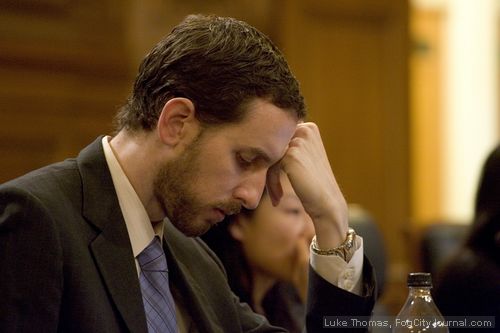
District 8 Supervisor Scott Wiener. File photo by Luke Thomas.
By Richard Knee
June 19, 2012
In moving to push Bruce Wolfe off the city’s Sunshine Ordinance Task Force on May 22, Supervisor Scott Wiener attacked the 11-member body in a way that was venomous and mendacious.
From the board dais, Wiener labeled the task force as anti-sunshine, accusing us of responding to an “audit” by saying, “How dare you?”
In making that statement, he lied. Twice.
First, there was no audit. An audit consists of a thorough examination of an entity’s operations and their net cost or benefit, including how much funding the entity receives during a given time span, how much it spends and the uses of those expenditures. No such report exists.
Second, neither the task force nor any member of it uttered the phrase “How dare you?”
The task force did, however, issue a strong statement objecting to (a) the surreptitious manner in which Wiener asked the Budget and Legislative Analyst to “survey” all city departments on how much it costs them to comply with sunshine (i.e. open-meeting and public-records) laws and on how many hours their personnel spend at task force meetings as respondents to complaints brought by members of the public; and (b) the survey itself, which we thought was vague and inconclusive.
What prompted the survey? Wiener said he had received complaints that the task force’s complaint-handling process was costing lots of overtime and keeping city personnel in City Hall late into the night.
It is true that task force meetings are often long. But that is not because the task force operates inefficiently. It is because our agendas often include upward of 10 complaints and we are duty-bound to give each a fair hearing, weighing the evidence that both sides provide in determining which, if any, provisions of local or state sunshine laws have been violated.
In addition, we get lots of public comment on virtually every matter that comes before us. A good deal of that public comment is, in fact, extremely helpful to us. But at times it stretches our meetings significantly.
Also important is that the number of complaints that the task force hears is only about a fourth or a third of those that our office receives; in most cases, our administrator is able to bring the two sides together.
Furthermore, while city personnel get overtime for attending task force meetings, task force members receive neither remuneration nor expense reimbursement for their service, which often requires juggling meeting schedules with family and job commitments.
Why does the task force receive so many complaints? There are a couple of plausible explanations. Ray Hartz Jr., a citizen watchdog of City Hall, told us recently that the task force’s copious workload stems from growing public awareness of the sunshine laws and of the task force’s role in upholding people’s sunshine-related rights.
If that’s true – and I like to believe it is – Hartz and a handful of others who regularly speak at task force meetings deserve a lot of the credit for it.
At the same time, there’s another, darker factor: the task force has no authority to impose penalties on sunshine scofflaws, and the entities that have that power have never used it. So the word has spread within City Hall that one can violate the Sunshine Ordinance and skate on it.
I’m not saying that every city department, agency, board, commission etc. thumbs its nose at the letter or the spirit of open government; many, maybe most, people in City Hall agree that it’s an essential component of democracy and do their utmost to further it. But there are enough perceived and actual violations to keep the task force plenty busy.
Finally, among the conclusions that the Budget and Legislative Analyst drew from the survey are the following:
• Compliance with state and local sunshine laws carried “identified” costs of about $4.27 million to the city in calendar 2011, of which nearly $3.28 million stemmed from adhering to state laws. So the Sunshine Ordinance added $997,676 to the cost of compliance.
Since San Francisco’s population is a bit over 805,000 the latter cost figure works out to about $1.24 per resident per year. I’d say that’s an excellent bargain.
What’s more, $4.27 million represents slightly more than 0.6 percent of the city’s $6.83 billion budget for fiscal 2011-12.
• “[I]t is likely that without the (task force), some portion of complaints would be directed to other public bodies, such as the courts, which would in turn incur costs.”
In other words, the task force, ponderous though its processes and procedures might seem, has saved the city untold hundreds of thousands of dollars in court expenses. And there’s no telling how many millions of dollars the local and state sunshine laws have saved the city by enabling the exposure or prevention of backroom deals.
By the way, an audit of the task force’s operations is a laudable idea. Supervisor Wiener or any other city official would serve the city well by initiating it.
Supervisor Wiener would also serve the city well by recanting his slander of the task force.
Next: how the Board of Supervisors’ purge of Sunshine Ordinance Task Force incumbents was an exercise in hypocrisy.


 The Hunger Site
June 21, 2012 at 7:32 am
What irony! For someone trying to squelch sunshine, Mr. Wiener is so totally transparent. This is obviously payback. The Sunshine Ordinance Task Force found Mr. Wiener in violation and he is mad. Remember that the Task Force was enacted by the people to expose this kind of childish shenanigans which our elected servants would prefer to have hidden from public scrutiny.
June 20, 2012 at 9:58 am
RUN RAFI RUN. Roast the Wiener.
June 20, 2012 at 9:19 am
Sunshine saves public dollars because it exposes otherwise concealed public dealings to the light of day.
Those who are attacking the SOTF see government dealings and “a little off the top” of each deal as their own private political property to be thrown to supporters and have no interest in saving public dollars, this is the corrupt political basis for these attacks.
This is neither liberal, progressive, moderate nor conservative, this is the corruption that greases the skids for further enriching the 1%.
June 20, 2012 at 9:16 am
Thank you Derek, for filling in the gap.
June 20, 2012 at 8:37 am
It’s just a survey — do it — big deal.
June 20, 2012 at 8:32 am
On September 27,2011 the Sunshine Task Force found that Supervisors Wiener, Chiu and Cohen had violated the Sunshine Ordinance in their handling of the Parkmerced Development contract.
So, on December 13, 2011 Supervisor Wiener asked the Budget & Legislative Analyst to conduct a
one-sided “Survey of Costs of Compliance with the City Sunshine Ordinance”. Wiener emphasized that the SOTF “must function effectively”. But “effectively” was defined solely as “costs” – not results or benefits.
It was political retaliation, and the SOTF appropriately requested an explanation from Wiener.
Then, the SOTF was purged by Supervisors Wiener, Chiu, Cohen, Farrell, Elsbernd and Chu.
Shamefully, this purge eliminated and excluded a physically disabled member from the SOTF – in violation of the Sunshine Ordinance.
June 20, 2012 at 6:57 am
My experience with the Sunshine Ordinance Task Force was the only positive one I have had when dealing with the City of San Francisco-knowledgeable, thorough, and fair. Too bad it doesn’t have any enforcement power. In my opinion, the biggest flaw in the system is having the City Attorney as the Supervisor of Records. The City Attorney doesn’t work for the citizens of San Francisco, rather the City Attorney is just that, the “City’s” Attorney. This arrangement creates a conflict of interest. While the Supervisor of Records is legally bound to enforce the disclosure of public records the City Attorney is tasked with protecting the City from lawsuits that disclosed public records might cause. The City Attorney is well aware of the costs of a lawsuit and knows that only a limited number of citizens will be able to pursue their rights through the courts if records are not disclosed as required by law. Perhaps the City would be more forthcoming if any determination by the SOTF meeting the definition of official misconduct resulted in a minimum of treble damages and attorney’s fees if the matter needs to be pursued in court or if such a determination barred an employee from the free legal services of the City Attorney in defense of any action taken based on findings of official misconduct. Additionally, citizens should have the time needed to pursue available administrative action before undertaking the often catastrophic costs of legal action. Citizens should be permitted to pursue administrative action provided by the City such as the SOTF and the agencies currently charged with enforcement of the SOTF’s determinations (the District Attorney and the Ethics Commission) without the City using the citizen’s pursuit of administrative remedy as a means of barring legal action based on the statute of limitations. Often, the City’s own actions result in unnecessary delay in administrative remedy and the City should not benefit from it in court. Citizens should have the right to exhaust all administrative means of resolution before proceeding to court and should: a) be exempt from the need to file a claim with the City prior to filing a lawsuit and b) have a minimum of two years to file a lawsuit after the conclusion of all available administrative remedy.
June 20, 2012 at 5:44 am
Supes. are now using supposed “complaints” , without divulging names or contents,, as basis for all sorts of regressive actions. As for Wiener’s attack on SOTF, remember he was a deputy city attorney. Some years ago, the office of the City Attorney complained about the time it took to respond to Sunshine-based info.requests, and even tried to bar one person from making such info. requests. So, it may have a basis in that earlier history of his former employer
June 19, 2012 at 6:35 pm
The question is why is Wiener attacking/going after the Sunshine Ordinance Task Force? Makes one wonder why.
June 19, 2012 at 5:09 pm
” Wiener said he had received complaints..”
I’d love to know just whose complaints he’d “received.”