
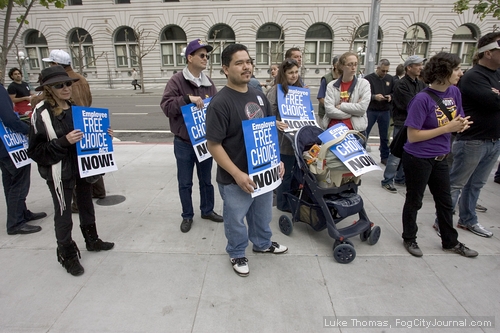
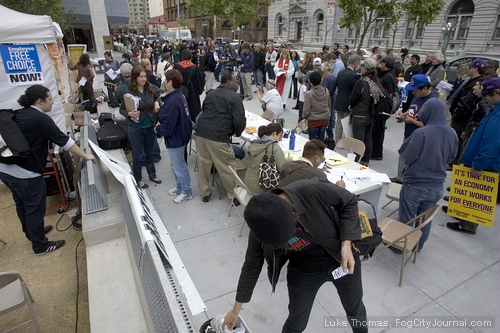
A rally was held Wednesday outside the San Francisco Federal Building
to urge Senator Dianne Feinstein’s support of the Employee Free Choice Act.
Photos by Luke Thomas
By Fanny Dassie
May 8, 2009
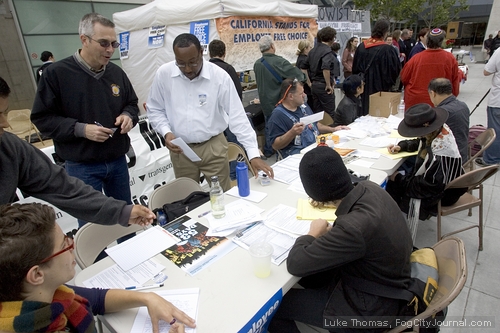
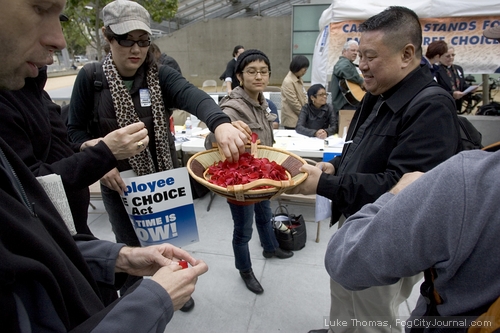
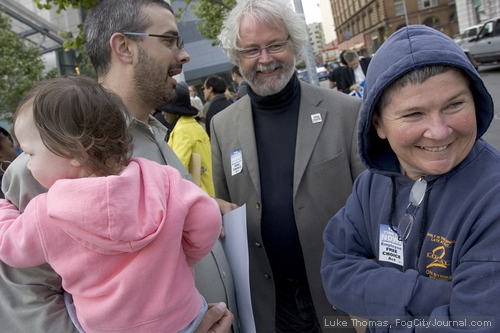
Bay Area workers and community members, supported by the California Labor Federation, held a rally Wednesday outside the San Francisco Federal Building in support of the Employee Free Choice Act (EFCA) and to urge Senator Dianne Feinstein and Washington DC lawmakers to pass the legislation.
“This is the most important legislation for working men and women of America since the Wagner Act was passed in the 1930s,” said San Francisco Labor Council Executive Director Tim Paulson. “It allows workers to choose whether or not they join the unions and not let the employers run the process.”
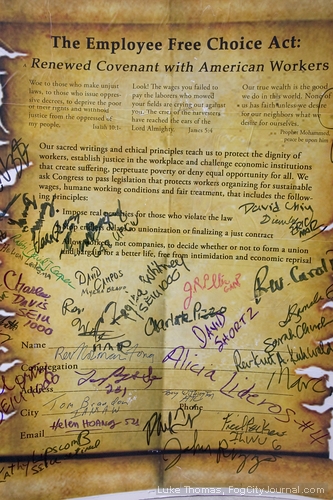
If enacted, EFCA would enable working people to bargain for better benefits, wages and working conditions by restoring workers’ freedom to join, or form unions. It would also remove existing obstacles to employees who want collective bargaining, and would require employers to recognize a union as soon as a majority of employees signed cards supporting unionization.
Passed by the House but rejected by Senate in 2007, the bill was reintroduced in March. For the Senate to proceed to a re-vote, at least 60 senators have to agree to invoke cloture, a process that aims at preventing a filibuster.
To reach a filibuster-proof 60 votes in the Senate, the bill would need the support from all 57 Democrats, the two independents – Senators Bernie Sanders and Joe Lieberman – and at least one other senator.
Paulson said he is confident the House will pass the law and hopes the Senate will do the same. He also explained that under the current system, “One out of four workers who try to join the union in a campaign are fired, and there is absolutely no repercussion whatsoever,” adding that employers use intimidation to discourage worker organizing.
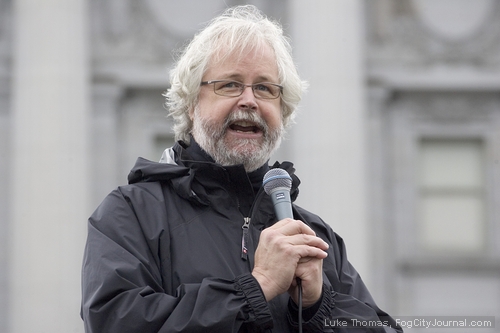
Tim Paulson
San Francisco Supervisor Chris Daly, who supports the passage of act, said workers have more bargaining power when unionized.
“When working people and everyday people are organized together, they are stronger, they can stand up to the corporate forces and special interests that, unfortunately, usually have more to say in the decisions that affect peoples’ lives,” he said.
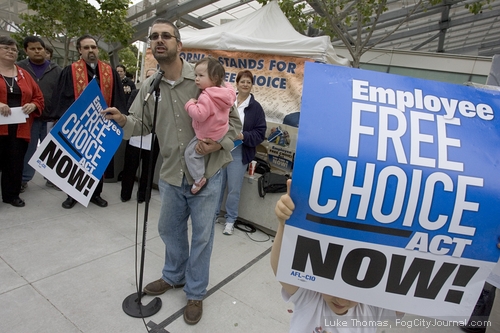
Supervisor Chris Daly
Feinstein, a past co-sponsor of EFCA, has yet to support the bill. She is said to be aligned with corporate interests and has expressed concern the legislation would make the economy worse.
“This is an extraordinarily difficult economy and feelings are very strong on both sides of the issue,” Feinstein said in a statement provided to FCJ by her spokesperson, Gil Duran. “I would hope there is some way to find common ground that would be agreeable to both business and labor.”
Reactions to Feinstein’s stated position was swift.
California Labor Federation Communications Director Steve Smith said, “This act is a critical component of rebuilding the middle class,” adding that he is “perplexed” that Feinstein does not support the bill given that President Obama and economists have said the legislation would help a boost a struggling economy.
“The campaign is still continuing,” Paulson said, pointing out the numerous calls and the tens of thousands of letters sent to Feinstein’s office. “We just continue to ramp up the pressure. There is no excuse for EFCA not to be passed.”
Luke Thomas contributed to this report.

 The Hunger Site
May 9, 2009 at 8:07 am
What’s criminal here is that unions bust ass to elect candidates, end up playing power games amongst themselves, and fumble at a time of crisis unprecedented in our lifetimes, just when working Americans need them the most.
If labor is at the point where labor leaders are holding a vigil instead of organizing workers to demand worker-friendly legislation from the President they worked so hard to elect, then we’re all toast.
I agree that it needs to be easier for workers to organize, but that said, organized labor needs to offer up solutions that are desired by workers instead of playing manipulative, Manichean power games amongst themselves for turf. It is almost as if COINTELPRO were being unleashed on labor to stymie progress.
-marc
May 8, 2009 at 7:17 am
The Employee Free Choice Act is the most important piece of legislation for Labor in 75 years. Current law around organizing unions is criminal. Union busting firms make hay out of this multi-billion dollar industry annually. I have been involved in campaingns where companies call ICE on their own workers once there is an attempt to organize. I have had workers attend mandatory anti-union seminars for weeks on end while on the clock. When workers challenge the company at these meeting those workers are terminated illegally. The remedy under current law is for the company to put up a poster that says they won’t do it again. The company can drag out elections for months on end and fire all pro-union workers…once they know the fix is in they allow the elction to go forward.
Even if a union rises above all these barriers and does become certified there is no law saying that the company has to give the workers a contract. We just went through a situation where the union was recognized by the NLRB in 2005 and we still have no contract in 2009 the company is not willing to sit down in good faith. After 4 years of struggle the workers give up and the company breaks the union without ever having had a contract.
All this and even once a union is
The Employee Free Choice Act would solve a big part of what is wrong with American labor laws.
Construction workers will still be able to be fired for honoring picket lines and it will still be illegal for unions to engage in boycotts of secondary and teriary companies. Strange in America that anyone can conduct a boycott for any reason but if a union does it suddenly it is unlawful. Nevertheless, the Employee Free Choice Act would strengthen labor’s numbers and perhaps we can turn some of these other things around.