
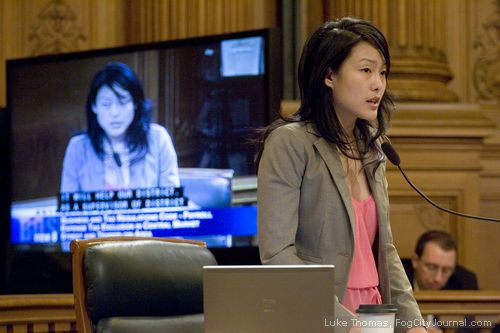
Tax exemption legislation aimed at preventing Twitter, Inc. from relocating to Brisbane as well as revitalizing Mid-Market and the Tenderloin neighborhoods, was championed by District 6 Supervisor Jane Kim. Photos by Luke Thomas.
By Luke Thomas
April 7, 2011
The San Francisco Board of Supervisors passed a payroll tax exemption for Twitter, Inc. Tuesday, legislation that aims to “revitalize” a stretch of Mid-Market Street and the low-income Tenderloin neighborhood.
The legislation was passed by an 8-3 vote amid concerns of gentrification impacts and without a promised Community Benefits Agreement (CBA). The legislation’s sponsor, Supervisor Jane Kim, who said two weeks ago the legislation would be continued until a CBA had been formulated and ratified by the Board, told FCJ after the Board vote Tuesday the tax exemption legislation is not actionable until a CBA has been approved.
“Two weeks was not enough time to have a good enough CBA come out of this and we weren’t able to setup all the meetings,” Kim told FCJ. “Twitter is now meeting with our public stakeholders – that was something that they hadn’t agreed to before – and the second thing is the trailing legislation is actually going to set up a process and so even the Twitter CBA is going to have to come to a public hearing before it gets approved.”
“Before Twitter gets the tax exemption, they have to have a public hearing on this CBA,” Kim added.
Kim estimated it would take approximately two months before a Twitter CBA agreement could be vetted by the public, ratified by the Board and signed into law.
Supervisor David Campos, who said he supports efforts to revitalize Mid-Market, opposed the legislation on the grounds that a CBA had not been established or vetted prior to the vote, a misstep, he intimated, that will remove community leverage to eek out substantive community benefits in exchange for the tax exemption.
“My preference would have been to see a Community Benefits Agreement that’s already in place, that’s actually finalized so that we can see for sure what it is that will be provided,” Campos said, adding that community residents will have little or no impact on the final CBA. “For me, that is insufficient and that’s a problem.”
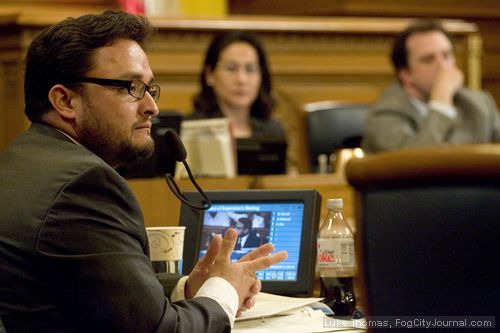
Supervsor David Campos
Supervisor Ross Mirkarimi, who voted against the legislation, said the CBA was being used as a “marketing tool in order to really justify and rationalize the advancement and passage of this legislation.”
“We deserve – and so does the public – deserves the right of having a complete vetting of what that CBA looks like in a hearing that does not compromise the process, so that it doesn’t look there’s collusion or that there’s any kind of undue influence because of due process as it relates to how a CBA is developed,” Mirkarimi said
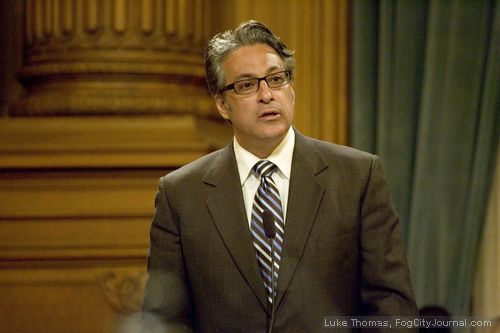
Supervsor Ross Mirkarimi
The deal with Twitter, hatched by then Mayor Gavin Newsom while seeking higher office, provides the popular messaging service company a projected $72 million tax haven on future payroll and stock option taxes on new employees for six years. Headquartered in San Francisco, Twitter threatened to relocate to Brisbane unless the City provided the corporation with the tax giveaway – even while the City faces a projected $380 million budget deficit during the worst recession since the Great Depression.
Supervisor John Avalos, who voted against the legislation, said businesses have a social responsibility to the communities in which they do business.
“I don’t believe giving an exception to our payroll tax is the way to go,” Avalos said. “I believe that businesses in San Francisco and around the country should be socially responsible and part of that social responsibility is paying our taxes.”
“Also, if we give these tax breaks, we are aiding and abetting the exacerbation of these disparities in wealth,” Avalos continued. “We should make sure that corporations are paying their fare share compared to middle-class people, working-class people. We’re getting gamed – we’re paying our taxes and we’re losing services.”
With an expectation of increased rents in the area as a result of the job creation incentive, businesses and low-income residents would face displacement and gentrification threats, Avalos said.
“We have to be concerned about displacement of current tenants and businesses,” Avalos said. “During the dot-com era, there were a lot of tenants who saw their apartment rents rise dramatically.”
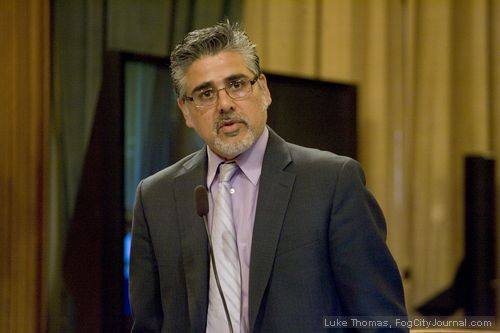
Supervisor John Avalos
“I am concerned about gentrification,” Kim responded to FCJ inquiry. “I’ve said that over and over again and that’s why I want a follow-up policy. I want economic revitalization so I want to address gentrification without risking losing a company like Twitter.”
Those Supervisors who voted for the legislation did so with reservations.
Supervisor Scott Wiener said he supports broad payroll tax reform but said any type of reform will create “winners and losers.”
“I’m not an advocate of willy-nilly tax cuts,” Weiner said. “I don’t think that’s the way to go. But when you do it in a focused, well-targeted way, it can work.”
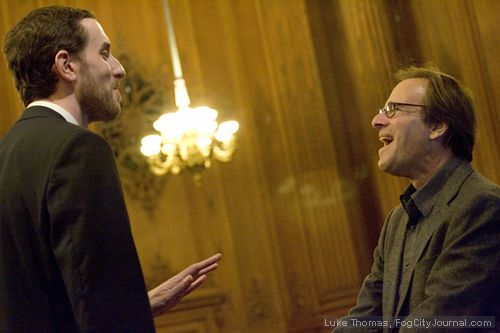
Supervisor Scott Weiner (left) with Tenderloin Housing Clinic Executive Director Randy Shaw, a vociferous supporter of the tax exemption.
“I share concerns like some of my colleagues of the gentrifying impacts and whether the jobs and the benefits to our city and neighborhoods will materialize with the plan,” Supervisor Eric Mar said.
Mar said he “strongly” supports the creation of a Community Advisory Committee “that gives empowerment to the people in the different neighborhoods to create the strongest possible Community Benefits Agreement to minimize the gentrifying impacts, and I’m not going to deny that this tax break will have a gentrifying impact, but I’ll just say that with Supervisor Kim’s efforts, it will at least minimize and mitigate that and will give some public transparency to the process of creating the benefits agreement.”
Though he said he supports effort to provide Twitter a tax exemption, Mar said he is concerned other corporations would be lining up for targeted tax exemptions.
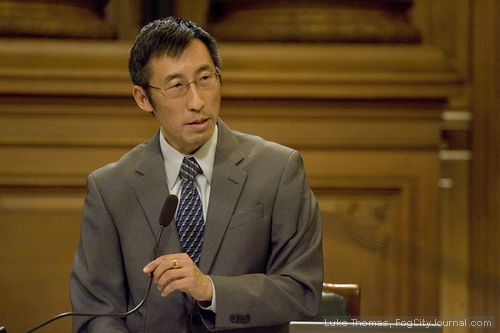
Supervisor Eric Mar
“I am enthusiastic that we all seem to realize our payroll tax system is broken,” said Supervisor Mark Farrell. “We need to do everything we can in City Hall to make sure that we are on solid footing and create a solid economic environment in San Francisco that does not hamper our ability to create jobs, attract companies and want people to locate here in our City.”
“In regards to this legislation, I do think that it’s unfortunate that is has devolved into a dialogue about one company,” Farrell added. “While I think that has been part of the debate, we cannot govern that way in City Hall. We cannot capitulate to one company time and time again. That doesn’t work for the long haul.”

Supervisor Mark Farrell with Tenderloin Housing Clinic Executive Director Randy Shaw, a vociferous supporter of the tax exemption.
“This vote is a tough vote for me,” said Supervisor Malia Cohen. “I am extremely skeptical of how the conversation has turned to focus on one particular company and less about the larger issues that of which it attempts to satisfy, which is stimulating Mid-Market.”
“This legislation attracts people to the Mid-Market area which is very good but also could have a negative and unintended consequence of wooing businesses to leave say the South-East, San Bruno Avenue, Mission Street, Ocean Avenue, to go join down in the Mid-Market area to capitalize on some of these benefits. So, yes, it stimulates Mid-Market. Yes, that’s awesome. But, however, it creates a void in the other respective surrounding neighborhoods. So I am very concerned about that. So I am in favor of the legislation – I will be voting for it – but it is with serious reservation and I am very aware of the mixed message we’re sending to our small business community,” Cohen added.

Supervsior Malia Cohen
Kim introduced amendments to the legislation including removing several blocks from the tax exemption inclusion zone and shifting contractual responsibility from the Mayor’s Office of Economic and Workforce Development to the City Administrator, a post interim Mayor Ed Lee, who supports the Twitter tax exemption, is expected to return to in January.
“As you know, the City Administrator has the overall responsibility for the management and implementation of policies, rules and regulations, promulgated by the Mayor and the Board of Supervisors and the voters, and this is something that Mayor Lee is committed to and insuring in terms of advocating for our communities and our neighborhoods and the CBA,” Kim said.
The Board will convene for a second and final vote next Tuesday.

Luke Thomas
Luke Thomas is a former software developer and computer consultant who proudly hails from London, England. In 2001, Thomas took a yearlong sabbatical to travel and develop a photographic portfolio. Upon his return to the US, Thomas studied photojournalism to pursue a career in journalism. In 2004, Thomas worked for several neighborhood newspapers in San Francisco before accepting a partnership agreement with the SanFranciscoSentinel.com, a news website formerly covering local, state and national politics. In September 2006, Thomas launched FogCityJournal.com. The BBC, CNN, ABC, NBC, CBS, Fox News, New York Times, Der Spiegel, San Francisco Chronicle, San Francisco Magazine, 7x7, San Francisco Examiner, San Francisco Bay Guardian and the San Francisco Weekly, among other publications and news outlets, have published his work. Thomas is a member of the Freelance Unit of the Pacific Media Workers Guild, TNG-CWA Local 39521 and is a member of the Society of Professional Journalists.
Follow Me:

 The Hunger Site
April 12, 2011 at 3:16 pm
Corporatocracy at its best.
April 7, 2011 at 3:57 pm
@h. Maybe I shoulda kept this ‘entre nous’, but as I opened my big mouth publicly, how unusual, I feel obligated to disclose fully.
SFGTV; April 5 meeting of SFMTA; Item 11.
It may be nothing; but it may be yet another of those chancres that infect our body politic.
One of those ‘issues’ that is considered routine business as usual by the powers that be; that goes unnoticed by the public who don’t have time, or interest, to follow the minutiae of downtown dealings or sit and wait two hours for their two minutes of public comment.
It sounds like a fait accompli and the rubber has been stamped; the ‘little’ guy looses again. But I find it ‘interesting’ that Whitney Leigh (Matt’s partner ?) is filing suit.
April 7, 2011 at 3:11 pm
… SFGOV broadcast of recent SFMTA meeting, something about Ford and a contractor sharing same attorney, Herrera’s name came up. Not sure I have time or expertise to find it but will try. Salon tomorrow maybe when Giants deal the Cards a loosing hand.
April 7, 2011 at 2:33 pm
Chris,
“replace it with a tax”? Good luck passing any serious tax in this town. My numbers including the $350 million for what will be lost yearly when we lose the payroll tax (second only to the property tax in bondable revenue) it will men 600 jobs for every 50 million. Maybe more jobs.
So, take the loss of those 3,600 jobs per year (if you don’t pass another tax worth that – as I said, Good luck Charlie) … You lose that yearly in that one category and then you have the exploding pension and health care for life liabilities blooming into a few more hundred million a year and pretty soon all of your City income is paying retirees and with an entirely privatized work force.
I could be wrong.
I hope so.
I doubt it.
Pat Monk, where’d you hear that “Herrera may be involved.”?
Go Giants!
h.
April 7, 2011 at 1:51 pm
I think I have gotten confused on one point. This is tax exemption on new jobs created? not current jobs so its not taking away current revenue, just future revenue if those jobs are created?
If I am correct your numbers are wrong H.
Ofcourse if I am incorrect your numbers are right.
Anyway that being said, replace the whole Pay role tax thing, that seems to be flawed as only being paid by a few SF companies anyway (and has never collected on Stock Options?) and replace it with a tax that may be collected on a large number of business and bring in more revenue to SF (.i.e. tax on Commercial Rents)
April 7, 2011 at 12:40 pm
More City Hall Shennanigans ?
@h or anyone. I saw the end of an SFMTA meeting a couple of days ago. Sounded like ‘action’ may be taken against Nathaniel Ford for alleged irregularity/conflict of interest in the awarding of contracts and that Herrera may be involved, anyone know what this is about ?
GIGANTES !!!
April 7, 2011 at 12:08 pm
Great piece of work,
I particularly liked D-2’s Mark Farrell’s comment: We cannot capitulate to one company time and time again.”. They’re setting a precedent and creating a template for tax avoidance which could end up costing us 350 million in General Fund Revenue by next year (if the Chamber of Commerce suggested legislation goes to the ballot box and wins in November – they want to get rid of the payroll tax completely). Slippery slope indeed. I mean, if SEIU is able to kill Pension Reform again and the City has to put another 300 million into that pot? With no new revenue we’ll be looking at cutting 3,000 jobs this year (at 600 lost jobs for each 50 million in lost General Fund revenue and a deficit of 300 million) and an additional 8,000 jobs next year (again, at 600 lost jobs per 50 million in deficit). That’s about half of the City’s work force getting pink slips in around 12 months.
Anyone wanna question my numbers?
I do like Eric Mar’s new hair doo.
Go Giants (catch opener at Daly’s Dive and Bulldog Salon)
h.
April 7, 2011 at 12:00 pm
MISSION CREEP.
Twitter > ZYNGA > THC > Burning Man > ???. Maybe this latest giveaway, oops ‘tax exclusion zone’ should be extended to include the Embarcadero so that Larry Ellison can maximise his profits.