
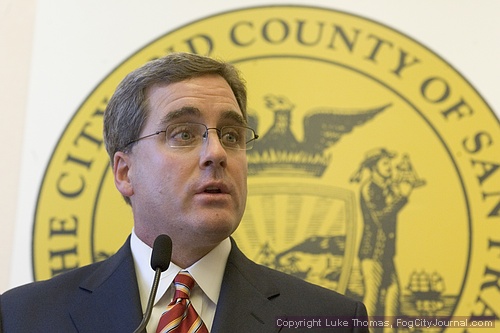
San Francisco City Attorney Dennis Herrera
Photo by Luke Thomas
From the Office of City Attorney Dennis Herrera
June 30, 2008
Gun Advocates’ ‘Factually Slipshod’ Legal Challenge Improperly Names S.F., Asserts Facts Contradicted By Their Own Exhibits
SAN-FRANCISCO – City Attorney Dennis Herrera today vowed to seek sanctions in Federal Court for a “factually slipshod” and frivolous lawsuit filed Friday by the National Rifle Association and the Citizens Committee for the Right to Keep and Bear Arms challenging a San Francisco ordinance that prohibits possession of firearms on such City-controlled property such as parks, hospitals, stadiums, and recreation centers.
Within hours of a U.S. Supreme Court ruling last Thursday that invalidated a District of Columbia handgun ban for violating the U.S. Constitution’s Second Amendment, gun advocates threatened new litigation against the cities San Francisco and Chicago in published news accounts nationwide.
This rush to sue, Herrera said, resulted in a case against San Francisco and the San Francisco Housing Authority amounting to little more than a publicity stunt that improperly names the City as a defendant, and makes false representations to the Court. Such frivolous and baseless allegations may give rise to monetary sanctions that the Federal Court may impose under the Federal Rules of Civil Procedure.
“In their apparent effort to maximize publicity for their pending challenges, the NRA lawyers’ hastily drafted complaint made glaring legal errors, and asserted facts that are not simply unsupported — but actually contradicted by evidence contained in their own exhibits,” Herrera said. “Their factually slipshod complaint makes plain that this case is a publicity stunt and a frivolous waste of judicial time and resources, which rules of court specifically prohibit. It is clear to me, and I believe it will be clear to the Court, that the NRA has improperly named the City in this action, and that this case is simply an effort to publicly harass their ideological foes.”
The NRA’s 7-page complaint filed in the U.S. District Court for the Northern District of California names the San Francisco Housing Authority and the City and County of San Francisco as defendants.
The suit seeks to invalidate San Francisco Police Code Section 617, a City law that bans the possession of sale of firearms or ammunition on City-controlled property. Examples of such property identified in the ordinance are “recreational and park property including but not limited to Golden Gate Park, the San Francisco Zoo, Hilltop Park and San Francisco’s parks and playgrounds,” among others.
Despite the absence of a single mention of housing in the City’s ordinance, the NRA charges that the measure forbids public housing residents “to keep any firearm for self-defense (or any other lawful purpose) in their public housing units.”
The NRA’s complaint states that the San Francisco Housing Authority is “chartered under special authority from the City and County of San Francisco.” In fact, the San Francisco Housing Authority is a separate legal entity from the City. It is a creature of state law and largely funded by the federal government, through the U.S. Department of Housing and Urban Development. The City does not operate or control SFHA property, and its residences are not covered by Police Code Section 617.
The NRA’s complaint additionally represents to the Federal Court that policies contained in housing authority lease agreements and house rules that prohibit possession of firearms and illegal weapons on SFHA property “derive and are based upon San Francisco Police Code sec. 617.” This representation ignores evidence that the NRA presented to the Court in its own exhibits that San Francisco Police Code sec. 617 was approved on August 1, 2007. A footer notation on every page of SFHA’s 22-page lease agreement, which the NRA also attached as an exhibit, makes clear that the document’s most recent revision was April 24, 2006 — more than a year prior to the enactment of San Francisco’s ordinance.
Rule 11 (b) of the Federal Rules of Civil Procedure provides that parties may be subject to sanction by the Court for filings that are presented to improperly harass or needlessly increase litigation costs; for making frivolous and unwarranted claims; and for asserting factual contentions lacking evidentiary support.
The case is Guy Montag Doe et al v. San Francisco Housing Authority et al, U.S. District Court for the Northern District of California, Case No. 08-3112.


 The Hunger Site
No Comments
Comments for Herrera Vows to Seek Sanctions Against NRA are now closed.