
By Steven Hill
November 22, 2011
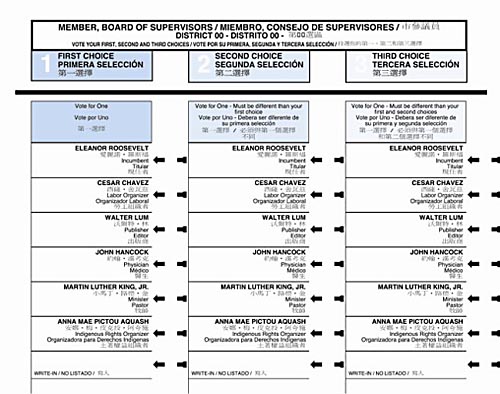
Recently Supervisor Sean Elsbernd and his allies at the San Francisco Chronicle launched their repeal attempt of ranked choice voting (RCV) by declaring that “9 out of 11 of the members of the Board of Supervisors were not elected by a majority.” But Elsbernd twisted the truth, intentionally using funny math to make his case.
Here’s what I mean. When it comes to RCV they are comparing FINAL round vote totals to FIRST round vote totals – what is known as a “Whole Contest” comparison. But when it comes to their preferred December runoff system, they are NOT doing a “Whole Contest” comparison because they don’t compare final round vote totals (in December) to first round vote totals (in November). In other words, they are comparing apples to oranges.
But if we compare apples to apples, a different story emerges. Look at these two charts below, in which I compare RCV elections that elected the current Board of Supervisors to the last competitive December runoffs that elected those same districts. The results are illuminating.
Board of Supervisors races, “Whole Contest” results:
|
District/winner |
Total |
Winner |
Instant |
Percent |
Exhausted |
|
D1-Mar |
28,756 |
13,152 |
50.7% |
45.7% |
2781 |
|
D2-Farrell |
24,094 |
11,426 |
50.6% |
47.4% |
1489 |
|
D3-Chiu |
27,198 |
13,582 |
59.4% |
49.9% |
4291 |
|
D4- Chu |
No instant runoff |
Outright majority |
|||
|
D5-Mirkarimi |
35,109 |
13,211 |
50.6% |
37.6% |
8998 |
|
D6- Kim |
21,086 |
8865 |
54.1% |
42.0% |
4664 |
|
D7- Elsbernd |
31,639 |
13,834 |
56.9% |
43.7% |
7314 |
|
D8-Wiener |
34,950 |
18,239 |
55.4% |
52.2% |
2009 |
|
D9-Campos |
26,486 |
12,637 |
53.8% |
47.7% |
2973 |
|
D10-Cohen |
17,808 |
4321 |
52.7% |
24.3% |
9503 |
|
D11-Avalos |
24,673 |
10,225 |
52.9% |
41.4% |
5294 |
|
43.2% |
19.4% |
||||
Board of Supervisors races by District, November-December “Whole Contest” results,
(most recent that was competitive):
|
District/Year |
November |
December |
Winner’s |
“Whole contest” percent |
“Exhausted |
|
|
D1-2000 |
24,211 |
14,373 |
7,486 |
30.9% |
9838 |
|
|
D2-never |
No Dec. runoff |
No runoff |
No runoff |
Outright |
||
|
D3-2000 |
21,066 |
12,414 |
7,202 |
34.2% |
8652 |
|
|
D4-2002 |
18,078 |
14,751 |
8,289 |
45.8% |
3327 |
|
|
D5-2000 |
30,125 |
15,887 |
10,384 |
34.5% |
14,238 |
|
|
D6-2000 |
18,738 |
10,470 |
8,472 |
45.2% |
8268 |
|
|
D7-Hall2000 |
30,229 |
18,627 |
9,333 |
30.9% |
11,602 |
|
|
D8-2002 |
27,101 |
21,091 |
11,096 |
40.9% |
6010 |
|
|
D9-never |
No Dec. runoff |
No runoff |
No runoff |
Outright majority |
||
|
D10-2000 |
19,764 |
10,649 |
5,887 |
29.8% |
9115 |
|
|
D11-2000 |
21,409 |
13,708 |
8,345 |
39.0% |
7701 |
|
|
36.8% average |
37.1% avg. |
|||||
That’s a lot of numbers to digest, but here’s what these numbers say, in a nutshell:
– With RCV elections, all current members of the Board of Supervisors were elected with a majority of “continuing ballots”(as indicated by the column called “Instant runoff percent”), which is how the San Francisco charter defines a winning majority;
– All current members of the Board of Supervisors were elected with an average of 43.2% of “whole contest” ballots. While that’s less than a majority, it’s WAY more than the “whole contest” winners elected by December runoffs, which averaged only 36.8%.
That’s because so many voters didn’t show up to vote in December – they are what I call “exhausted voters.” In fact, in ten of the city’s 14 December runoffs between 2000 and 2003, voter turnout declined by more than a third. So while races that elected the current Board of Supervisors had an average of 19.4% in “exhausted ballots,” the last competitive December runoffs in their districts had an average of 37.1% in “exhausted voters” – nearly twice as many!
In fact, when we compare all December runoffs to all “instant runoffs” that have been held, we find:
– In all the December runoffs, winners had 8,500 votes on average; but in all the instant runoff contests, winner’s on average won over 11,000 votes.
– December runoff winners’ had “whole contest” vote totals equivalent to 36% of the November vote total; but instant runoff winners’ had “whole contest” vote totals equivalent to 45% of first round vote totals, which is a huge increase.
– December runoffs had 38% exhausted voters on average; but instant runoffs had less than half that amount in exhausted ballots, only 17%.
In a nutshell, when comparing apples to apples, RCV elects winners with much higher vote totals, a higher “whole contest” vote total (percent of final round/election to the first round/election) and fewer exhausted voters/ballots than December runoffs.
That means with RCV, a LOT more San Franciscans are having a say in who their elected office holders are. In virtually every RCV race, candidates are winning with far more votes than they would have received in a low turnout December runoff, because with RCV we finish the election in November when voter turnout usually is highest. That means “instant runoff” winners have a MUCH GREATER VOTER MANDATE than December runoff winners.
The ultimate irony is that Sean Elsbernd himself is the poster child for what’s wrong with the old December runoffs and what’s right with RCV. Look at the results above for District 7: Supervisor Elsbernd won in 2004 in an “instant” runoff race with nearly 50% more votes than his predecessor Tony Hall had in 2000 in a delayed December runoff, 13,834 votes versus 9333 (in comparable turnout years). And Elsbernd had 43.7% of the “whole contest” vote total compared to 30.9% for Hall. No matter how you want to count it, more District 7 voters were able to have a say in who their supervisor is because Sup. Elsbernd was elected with ranked choice voting in a much higher turnout November election.
That’s what you call a mandate, Supervisor Elsbernd.
Supervisor Sean Elsbernd.


 The Hunger Site
November 23, 2011 at 12:36 pm
The argument as to whether the traditional form of election or ranked choice is better/fairer/ seems to be premised on whether a progressive candidate is likely to win. Maybe, a majority of voters do not prefer a so called progressive for mayor. I personally prefer the old system where if a candidate does not get 50+% in the first round then the top two candidates have a runoff. So what if this system costs more. Perhaps, we should also factor in the system of paying persons to run who then can’t drop out because they would have to pay the money back. I wonder how many candidates would hae entered the race or stayed in if City money wasn’t a factor.
November 23, 2011 at 10:37 am
@Eric, we do not know what would have happened in a runoff.
Do you really have such a dim view of progressive prospects?
Why do you even get out of bed every day?
There is a rough 20% and falling remaining progressive base. John got almost all of that and would have made a runoff a priori.
-marc
November 23, 2011 at 2:33 am
But it would not have been Avalos in the runoff against Lee under the old system…
Under the old system, voters, fearing the ‘spoiler effect’, would have voted for a candidate that they perceived as a ‘safe’ challenger for Lee like Herrera or Yee. Avalos would not have finished second with those kind of dynamics at play.
It is only because voters knew that under IRV they had the freedom to choose a more radical candidate without fear, that Avalos did so well.
November 22, 2011 at 9:46 pm
@Chris J, turnout in a primary is generally lower in all instances. The general election is what counts. There are generally more than three candidates in every race, and I’d cast my lot with few candidates earning an absolute majority now, just as few earn an absolute majority under the old system or RCV. I’d have no problem requiring the top two finishers in the primary ratified in the November general election. That is why it I’d called it a primary rather than a general election and a runoff.
It would take some work to compare September and November turnout in NYC as their primaries are partisan. I’m under the impression, would like to have it confirmed, that CA requires local elections to be nonpartisan. I don’t know of any data on the table that leads to the conclusion concerning turnout levels of a potential September primary versus a November election.
It turns out that IRV proponents claim that everything but IRV has lower turnout except for IRV when it has low turnout in which case it is not a problem. Didn’t Ammiano used to talk about the dangers of walking down both sides of the street? Pay no attention to the man behind the curtain. The Great Oz Has Spoken!
Gonzalez endorsed Gascón for satan’s sake. Why would you try to make an argument based on the progressive credentials and positions of someone who’s politics have diverged significantly from his positions in 2003? Gonzalez just supported a pro-death penalty former Republican for DA just because he gave Adachi the time of day just because Harris never did?
Quibbling with margin of error percentage differences taken from decades old memory is just picayune and distracts from the substance of the discussion, as does argument by associative cooties or anti-cooties. Please, you can do better than that. Maybe you can’t and that’s why you resort to such rhetorical tactics.
-marc
November 22, 2011 at 8:39 pm
“Ammiano got 25% in the ’99 primary, 40% in the ’99 runoff. Gonzalez got 19.5% in the primary and 47.5% in the ’03 runoff. Avalos got 18.5% in IRV.”
Marc, it’s not fair simply to say that Avalos got 18.5% in IRV. That was in the first round, which is comparable to a primary (and actually, the number is 19.3%). So he did about the same as Gonzalez in the ’03 primary. (Another correction: Gonzalez actually got 47.2% in the ’03 runoff.) In the final round, Avalos got 40.4%, which is the more appropriate number to use when comparing with runoff percentages. 40.4% is on par with Ammiano’s ’99 showing.
Finally, I want to note that all of the people you mention (Ammiano, Gonzalez, and Avalos) are strong backers of ranked choice voting, while the Chronicle et al are strong opponents. If you’re right, that would mean that every one of these folks on both sides is supporting a position that is against their own electoral interests.
November 22, 2011 at 7:21 pm
Marc, turnout in a September municipal election would be significantly lower compared to November, just like turnout in December and June are on average significantly lower. Moreover, that lower turnout would be borne disproportionately by those who are harder to turn out. Unless you force the top two to participate in November no matter what, you would have situations where a low turnout September election is electing candidates to office.
And all of this would be on top of the added expense of campaigning twice, combined with the mud-slinging and soaring independent expenditures characteristic of one-on-one runoffs..
November 22, 2011 at 6:04 pm
Agnos considers himself a progressive, so that counts as one (and almost Gonzalez) vs none for RCV. RCV, along with free money from the City, gave us aproximately 15 candidates whose platforms spanned the entire spectrum of political views in SF (moderate left to extreme left), none of whom outside the 2 leading vote getters garned much support. Don’t you think San Franciscans would have liked a run off between Avalos and Lee? I think we would have had a much more complete vetting of the 2 candidates, unlike the debates that lacked adequate depth. And I don’t think (Lee) would have been able to skirt a mano a mano debate.
November 22, 2011 at 3:46 pm
@Eric, Moscone and Agnos. Ammiano got 25% in the ’99 primary, 40% in the ’99 runoff. Gonzalez got 19.5% in the primary and 47.5% in the ’03 runoff. Avalos got 18.5% in IRV. Who’s to say that Avalos could not have built a strong coalition with Yee and Herrera, perhaps others, to equal or better Gonzalez ’03 in the ’11 runoff that never happened?
The massive grassroots runoff efforts, dollars and time, is an investment paid greater benefits the long run than the resources put in.
-marc
November 22, 2011 at 1:49 pm
@Marc – Tell me. In all of the decades that we had traditional runoff elections, how many progressive Mayors have we elected?
Let’s improve IRV by expanding the number of choices voters can rank for each race.
That’s a lot easier than expending the massive grassroots effort, dollars and time required to fight an incredibly well funded and corrupt Downtown machine in two separate elections for the same bleeding office.
November 22, 2011 at 12:06 pm
Well put, marc.
November 22, 2011 at 11:12 am
Choice of electoral systems involves choosing between sets of tradeoffs. There are benefits and detriments to both IRV and runoffs. To progressives and community based campaigns contesting with corporate economic power for local political power, the trade offs have been worse with IRV than with runoffs, even scant December runoffs.
These trade offs have entailed a loss of the organizing opportunities which runoffs provided in 1999, 2000 and 2003.
In electoral politics, everything we do but elect a candidate is as important as the actual election of a candidate. The community organizing required to elect the candidate and the organizing to keep the candidate in line once elected are politically valuable. Absent those two functions, we might as well not elect candidates.
Such are the lessons of those schooled in comparative politics when confronted with the realities of electoral and issue organizing politics.
The empirical data on loss of progressive and neighborhood power since IRV demonstrates clearly that IRV is a suicide pact for progressives and neighborhoods.
The ostensible benefit of IRV was as a stepping stone towards greater electoral reform in partisan races. The logic was that Green Party candidates would not receive the vote percentages that reflect popular support for Green policies because voters feared spoiling the Democrat by denying them a majority over the Republican.
There has been no stepping stone after a decade and there does not seem to be any indication of progress on the partisan front. I’d argue that the position is mistaken, that voters are not voting for Green Party candidates in partisan races because most Green Party candidates are wing nuts who do not inspire voters to offer up keys to the government.
The Occupy movement has more of a chance of making structural change to US politics than the path through IRV does.
I’d support repealing IRV in SF and moving towards a nonpartisan September primary/general election with a nonpartisan November general election/runoff. Call each election what you would, but this model will allow for progressive and neighborhood organizing to more effectively contest with corporate power while eliminating the doldrums December runoff.
The IRV experiment in SF has failed, the 2007 and 11 mayoral races are testament to that as is progressive political collapse. Time to cut our losses and move on.
-marc