Pelosi speaks to dissonance
on Iraq war funding
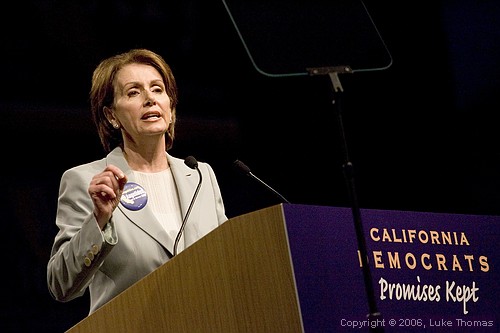
Congresswoman Nancy Pelosi addresses delegates
at the California Democratic Convention in Sacramento.
Photo(s) by
Luke Thomas
May 1, 2006
By Luke
Thomas
Congresswoman and Speaker Nancy Pelosi will have a "whole
different policy" regarding the war in Iraq when - and if
-she becomes the majority speaker in congress in November.
"Well, if I become Speaker of the House, we have a whole
different policy," Pelosi said. "You have to think completely
differently. You talk about an agenda for change, an agenda for
progress, an agenda that says 'if you want peace, work for justice.'"
That scenario largely depends on San Francisco voters who will
either continue to support a representative largely at odds with
its anti-war constituents, or look to alternative congressional
candidates promising San Francisco voters to do all they can to
end the war in Iraq, including voting against war appropriations.
To date, Pelosi, who voted against going to war in Iraq, has
not missed a vote in support of appropriations for the war, thus
enabling the Bush administration to sink over $170 billion of
tax-payer money into a war that has resulted in over 2,400 US
deaths, and by conservative estimates, the deaths of as many as
50,000 Iraqi civilians.
According to Pelosi, appropriating war funds should not be construed
as being in support of war.
"As long as our troops are in harms way, we have to take
care of them," Pelosi explained. "There's just no question
about it. We cannot leave them abandoned. They didn't make the
policy.
"They're at risk and you can't say to them ' we're cutting
off your supplies and your food.' Stopping the funding did not
stop the war in Vietnam. The war was over a couple of years before
they stopped the funding. There just is no correlation. People
have that impression, but what you have to do first is to get
the troops out of harms way," Pelosi added.
For many San Francisco voters, Pelosi's support for war appropriations
is seen as tacit support for sustaining the war in Iraq.
Pelosi, the current speaker for the congressional minority, is
expected to become the next Speaker of the House if Democrats
are successful in their bid to take back congress.
For this to scenario to play-out favorably, the Democratic Party
has to appeal to more moderate and conservative voters across
the nation.
But Pelosi needs to win her own district - even if Democrats
are successful in winning back congress. With two years before
US voters return to the polls to elect a new President, the Democratic
Party could muster enough congressional support for impeachment
of both President Bush and Vice President Dick Cheney, thereby
paving the way Speaker Pelosi to become the first female US president.
But to do that, Pelosi has to win her own District and
San Franciscans have a valid concern that Pelosi is not representing
the anti-war will of the majority of her constituents.
Addressing those concerns, Pelosi said, "I think most people
in our district want the war to end. We just have to end it. It's
not a question of depriving our troops the protection they need;
it's a question of changing the policy that is there. And I understand
their frustration for past mistakes."
Green Party congressional candidate, Krissy Keefer, an anti-war
activist, artist, and a mother, said in a telephone interview,
"Eighty percent of San Francisco constituents are against
the war in Iraq. Regardless of Pelosi's personal and professional
dilemma, she does not represent San Francisco, a constituency
that comprises some of the most forward thinking voters in the
United States."
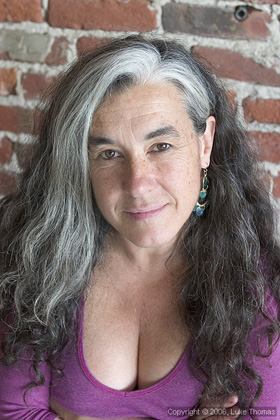
Krissy Keefer
####
|


 PRINT
THIS STORY
PRINT
THIS STORY


