WITH GEORGE CALYS
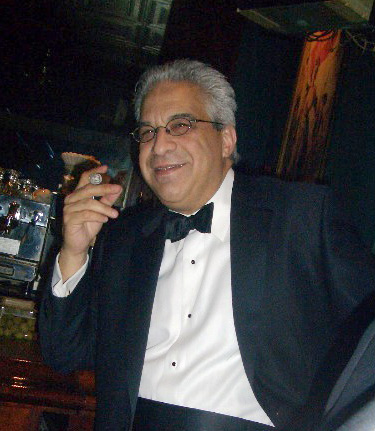
Photo courtesy George Calys.
One Year After: The De Young Museum
By George Calys
October 12, 2006
"We shape our buildings and afterwards, our buildings shape
us." --Winston Churchill
Nowhere in America does the average citizen have more opportunity
to "shape our buildings" than in San Francisco. From
community meetings to planning commissions to public design reviews,
San Franciscans have a tremendous amount of influence on the built
environment and newly proposed structures.
Our recent municipal history is rife with altered and cancelled
projects. The giant Coke bottle at AT&T Park was almost scrapped
because of neighborhood complaints, until a compromise was reached
by placing the bottle in a nearly horizontal position. Remember
the proposed Prada store by famous Dutch architect Rem Koolhaus?
The Planning Department stretched an unfavorable and complex review
out for so many months until the retail economy tanked and Prada
decided their old San Francisco store would do just fine.
A year after it opened, the battle over the new de Young Museum
is still fresh in our collective memories. How did we think and
feel and speak about the building that would soon contain one
of the City's most important collections of art?
From the moment it was announced that it was not feasible to
seismically upgrade the old de Young, controversy began to swirl
about what might take its place. Leading the charge for a new
museum, wealthy arts patroness Dede Wilsey began a massive private
fundraising effort.
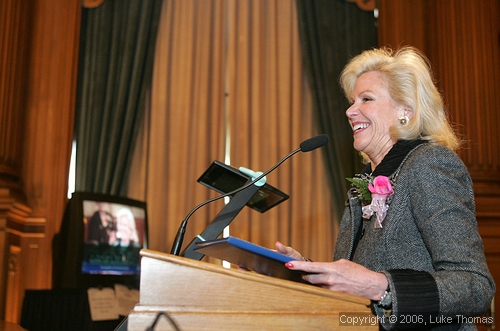
Dede Wilsey. File photo (3/8/2006)
Photo by Luke Thomas
In Wilsey's mind, there was no question, "this had to be
a modern building." The traditionalists groaned when international
architects and committed modernists, Herzog
and de Meuron were commissioned to design the museum. The
tastemakers of San Francisco who deemed Mission
Revival and Neoclassicism
the only acceptable styles for Golden Gate Park were about to
be shaken from their perches.
And so construction began. The building looked huge although
the footprint of the new museum was only 53% the size of the old.
Its exterior was some sort of funny, stamped, perforated metal-copper!-that
was unlike anything the Park had ever seen. As the copper skin
began to envelop the building, many observers commented that it
looked like a "battleship".
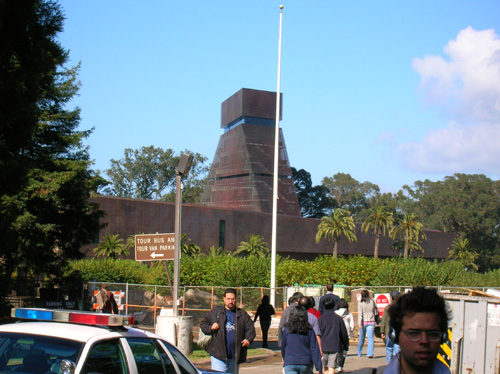
The De Young Museum closely resembling a "Battleship".
Photo by George Calys
San Francisco author, Samina Ali, was "offended" when
she first saw the copper panels being put in place. "My running
group went by the museum one day during construction. I was shocked.
The copper seemed so red, so very red. It didn't seem to fit into
its environment and, hence, didn't seem to fit into San Francisco."
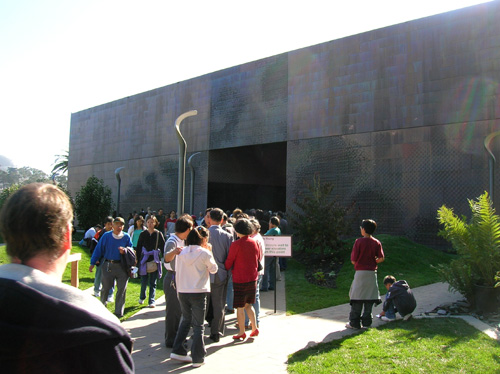
Copper panels greet visitors to the De Young Museam.
Photo by George Calys
But to Irit Axelrod, a Tel Aviv architect now practicing in San
Francisco, the embossed copper skin was "an exciting example
of digital architecture. It's a skin that is so complex and so
rich, that it is only possible to design it with a computer-that's
why it's referred to as digital architecture."
Far and away, the most controversial aspect of the design was
the tower. With its twists and angles it first appeared to be
the work of a drunken carpenter. At 160 feet, the height of tower
was objectionable to many who publicly commented. No one seemed
to recall that the old museum had a tower of 135 feet. Or that
in fog-obscured Golden Gate Park, the tower was often not visible
from outside the park.
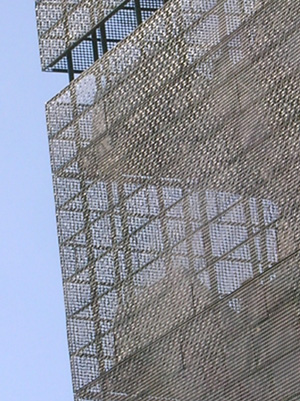
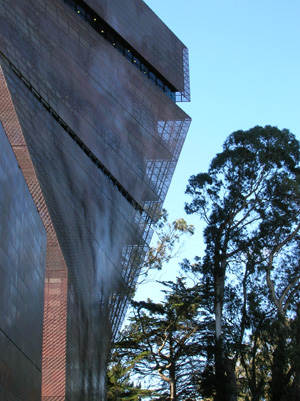
The De Young Museum tower.
Photo by George Calys
In brilliant bit of political maneuvering, the museum backers
agreed to shorten the tower and then reminded everyone that it
would house the museum's educational facilities. The mantra of
"educational facilities" made the existence of the tower
bullet-proof against the objections of the Park's neighbors.
"The old tower wasn't accessible and people couldn't go
up in it," recalls Axelrod. "That's why no one remembers
that the old de Young had a tower. In contrast, the geometry of
the new tower addresses the views and allows the museum visitor
to experience the Park in a whole new way."
The true test of every art museum is how it showcases the art
collection and how visitors are guided through the various galleries.
Unlike the Sistine Chapel in Rome or the temple and rock gardens
of Kyoto where art and architecture are completely integrated,
the modern art museum must resolve a core contradiction-how to
create a civic and architectural statement while at the same time
focusing on and not overshadowing the art within. "I had
to admit, my eyes were more attracted to the building itself,"
commented Ali. "Is it really a museum or is it just attracting
attention to itself?"
But Axelrod found a vocabulary of "irregular spaces in the
building: a narrow space; a tall space; an unexpected staircase;
they all contribute to the visitor's movement through the museum.
Every detail has been considered and contributes to the patron's
movement through the building." She concedes that there is
no "wow" space, no grand lobby to impress the visitor
upon entering the museum. "It's a much more subtle approach,
an approach based on surprise or juxtaposition." For Ali,
those "surprises" drew attention to the building and
away from the art. "I like the big open staircase, but I
felt like the rest of the interior didn't utilize space very well."
Will future San Franciscans' attitudes about the de Young change?
Can the building win a place in the City's heart? Ali is not so
sure. "It looks big and imposing in the Park. I don't know
if people can ever accept that.” “Time is required,"
says Axelrod, "it takes a long time for people to adjust
and get used to something new, something out of the ordinary.
But it will happen."
And so the debate continues. Is the de Young a daring piece of
"digital architecture"? Or is it an oversized statement
about itself to the detriment of the art inside? Or is the debate
really about San Francisco's reluctance to accept innovation in
our buildings, San Francisco's unwillingness to embrace any architecture
which does not copy the past?
George Calys is an architect and hack writer who lives
in San Francisco. He loves long walks through deserted alleys,
chain-smoking, borrowing money from friends, and has yet to be
discovered by the City’s social set.
Email George at: gcalys@yahoo.com
####
Editor's Note: Views expressed by columnists
published on FogCityJournal.com are not necessarily the views or beliefs of
Fog City Journal. Fog City Journal supports free speech in all its varied forms
and provides a forum for a complete spectrum of viewpoints.
|


 PRINT
THIS STORY
PRINT
THIS STORY


